


Turkey occupies a unique geopolitical position at the crossroads of Europe, Asia, and the Middle East, controlling the strategically vital Bosporus and Dardanelles straits. This geography has turned the country into one of Eurasia's most critical logistics hubs. In 2025, Turkish ports set a record with 553.3 million tons of cargo and 14 million TEUs, and in 2026, the milestone of 14.1 million TEUs is projected to be reached.
In this article, we will examine in detail three key container ports in Turkey — Ambarli (Istanbul), Mersin, and Izmir (Aliaga) — which play a defining role in international trade flows.
Port of Ambarli: Istanbul's Gateway to the Sea of Marmara
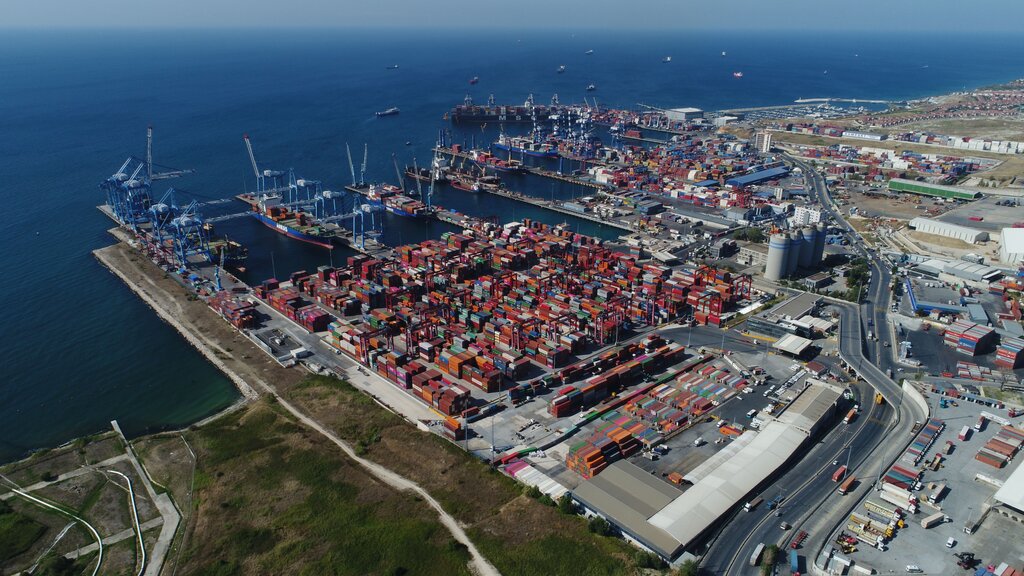
Ambarli is Turkey's largest container hub, located on the European shore of the Sea of Marmara, 35 km west of central Istanbul. Thanks to deep-water berths with a draft of 14–15 meters, the port can accommodate the largest container vessels transiting the Bosporus and Dardanelles straits.
Capacity and Terminals
Design Capacity: Approximately 4.0 million TEUs per year.
Actual Throughput (2024): 3.0 million TEUs (75% utilization rate).
Main Terminals:
Marport: The main terminal, handling ~477,000 TEUs per year.
Marport West: Handling ~112,000 TEUs per year.
Marport East: Specializes in feeder services.
Kumport: One of the largest private terminals in the region.
Strategic Role
Ambarli serves as a key transshipment hub for cargo moving:
From Black Sea countries (Russia, Ukraine, Romania, Bulgaria) to the Mediterranean and onward to Europe.
From Asia to Southern and Eastern Europe via the straits.
Within the framework of domestic cabotage services in Turkey.
New Infrastructure Projects
Due to high congestion at Ambarli, Turkey is actively developing alternative capacities. A new terminal, Asyaport, is under construction on a 320,000 m² site with a design capacity of 2.5 million TEUs. Once operational, it will enter the top 100 container ports globally and relieve pressure on the Istanbul hub.
Port of Mersin: Turkey's Mediterranean Gateway
Located on the southeastern coast of the Mediterranean Sea, Mersin is the largest container terminal in southern Turkey and a strategic gateway to the markets of the Middle East, North Africa, and Central Asia.
Capacity and Terminals
MIP (Mersin International Port): The primary operator and largest terminal.
Current Capacity: Approximately 2.6 million TEUs per year.
Planned Capacity (post-2026): 3.6 million TEUs.
Large-Scale Expansion: East Med Hub
In 2025, the first phase of the new East Med Hub terminal was completed at a cost of $455 million, marking one of the largest infrastructure projects in Turkey's port industry. Full completion is scheduled for 2026, after which the Port of Mersin will become one of the country's largest container hubs, capable of handling more cargo than Ambarli.
Strategic Role
Transit Hub: Mersin is actively used for transshipping cargo from Middle Eastern countries (Iraq, Syria, Lebanon, Jordan) to Europe and back.
Export Node: A significant share of Turkish agricultural exports (citrus, vegetables, fruits) to the EU and Russia flows through this port.
Energy Terminal: The port also handles oil and petroleum product shipments.
Port of Izmir and Aliaga: The Aegean Hub
Izmir is Turkey's third-largest city and a major logistics center on the Aegean Sea. However, the main driver of container growth in the region is not Izmir itself, but the neighboring industrial port of Aliaga, located 60 km to the north.
Capacity and Dynamics
Current Throughput (Aliaga): Approximately 2.1 million TEUs per year.
Growth: In 2024–2025, the port showed a record growth of 33.6%, becoming the primary driver of Turkey's container industry.
Infrastructure: Large-scale terminal modernization projects and berth deepening initiatives.
Strategic Role
Industrial Hub: Aliaga serves petrochemical plants, metallurgical enterprises, and regional energy facilities.
EU Trade: The port maintains direct, regular shipping lines with ports in Greece, Italy, and France.
Alternative to Istanbul: An increasing number of shippers are choosing Aliaga to avoid congestion and high tariffs at Ambarli.
Structure of Cargo Flow Through Turkish Ports
Main Export Cargoes
Agricultural Products: Turkey is one of the world's largest agricultural exporters (reaching $31.4 billion in 2024). Containerized shipments include citrus fruits, nuts, dried fruits, olive oil, and tomatoes.
Textiles and Apparel: Finished goods from Istanbul, Izmir, and Bursa.
Automobiles and Auto Components: From plants operated by Ford, Toyota, Hyundai, and other manufacturers.
Home Appliances: Vestel, Beko, and Arçelik are among Europe's largest producers.
Rolled Metal and Building Materials.
Main Import Cargoes
Energy Carriers: Oil, gas, and coal (for the industrial centers of Aliaga and Izmir).
Industrial Raw Materials: Chemicals, plastics, and metals.
Electronics and Components: From China, South Korea, and Taiwan.
Consumer Goods: From Asian and European countries.
Integration with Russian Logistics
Turkish ports play a pivotal role in trade with Russia:
Black Sea Corridor: Novorossiysk ↔ Ambarli (2–4 days sea transit) — the shortest and most popular route.
Baltic Corridor: St. Petersburg / Ust-Luga ↔ Istanbul / Izmir (7–12 days) — an alternative route for cargo originating in or destined for the Northwest.
Equipment Balancing: The export-import ratio of container equipment between Russia and Turkey is approximately 70%, creating specific challenges for logistics operators regarding empty repositioning.
Practical Conclusion
The Turkish ports of Ambarli, Mersin, and Izmir (Aliaga) form a powerful logistics triangle, ensuring seamless connectivity between Europe, Asia, and the Middle East. Active investments in capacity expansion (especially in Mersin) and the construction of new terminals (Asyaport) demonstrate Turkey's strategic commitment to developing container logistics. For shippers from Russia, these ports remain among the most accessible and reliable entry points to the markets of the Middle East, Africa, and Southern Europe.
*The information on this page does not constitute a public offer.
*MyContainers is a partner of MyWay.