
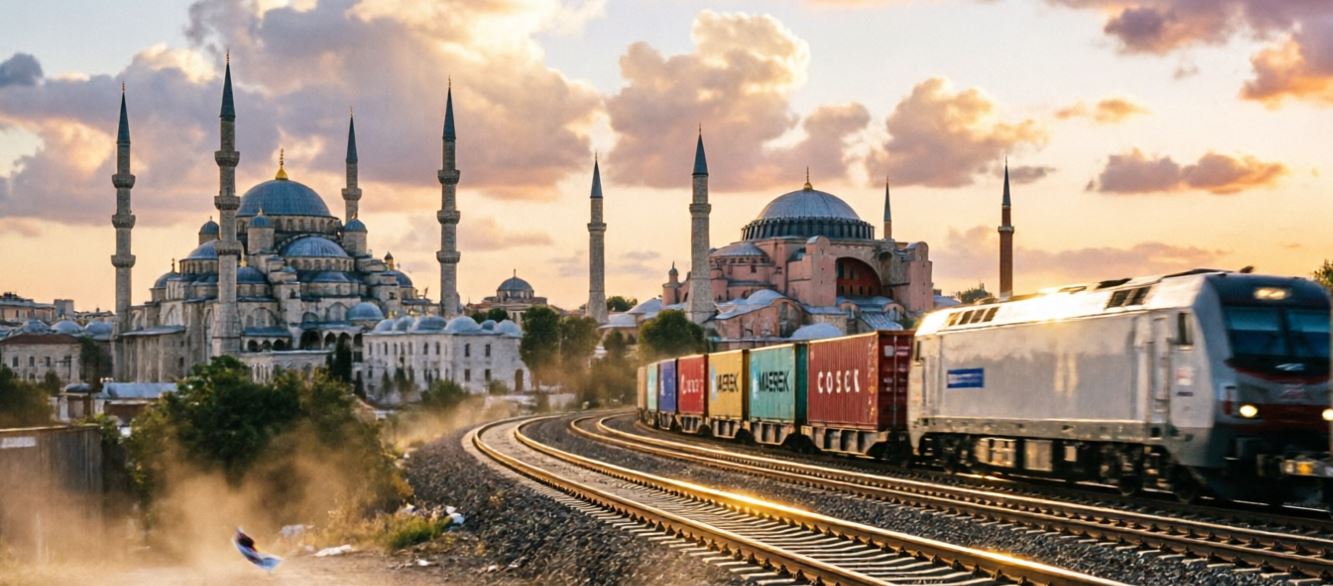
While global logistics searches for alternative routes, the Baku–Tbilisi–Kars (BTK) corridor, combined with the underwater Marmaray rail tunnel, has become one of the most technologically advanced and predictable container shipping routes from Central Asia and China to Eastern and Central Europe.
This path allows cargo arriving via the Caspian Sea to bypass unstable Black Sea ferry crossings and cross Turkey directly by rail, reaching the EU border (Kapıkule station) and continuing into Bulgaria, Romania, or Hungary.
However, the "seamlessness" of this route on paper often crashes into harsh reality: railway gauge changes, strict axle load limits in Turkey, and customs barriers. Let’s explore how this connection actually works and how MyContainers helps you navigate it without cash flow gaps or forced transshipments.
Anatomy of the Route: From the Caspian to the EU Gates
The route is a classic multimodal chain with two critical infrastructure changeover points:
Caspian Crossing (Aktau/Kuryk – Baku/Alat): The container arrives by ferry in Azerbaijan. This is the standard leg of the Middle Corridor.
Rail Leg: Baku – Tbilisi – Kars (BTK): The train travels along the Azerbaijani and Georgian railways (1520 mm gauge) to the Akhalkalaki station (Georgia) or directly to Kars (Turkey), where the first gauge change to the European standard (1435 mm) occurs.
Marmaray Tunnel (Istanbul): The key advantage of the route. The freight train passes under the Bosphorus Strait via a dedicated rail tunnel, bypassing the strait's ferry crossing, which is weather-dependent and causes multi-day queues.
Exit to Europe (Kapıkule – EU): After Istanbul, the train heads to the Kapıkule border station on the border with Bulgaria. Customs clearance for EU entry takes place here, and the train proceeds deeper into Europe.
Hidden Limits: Why Weight Matters
The main technical trap of the BTK–Marmaray route is the axle load restrictions on Turkish railways (TCDD).
While a standard 40-foot container (Max Gross) can weigh up to 30,480 kg, Turkish infrastructure on certain sections (especially in the mountainous terrain before Ankara and through the tunnel) has strict limits.
The maximum weight of a loaded 40-foot container for this route is often artificially capped at 22,000 – 24,000 kg (instead of the possible 26,000+ kg).
Exceeding this limit will result in the train being denied movement, requiring a costly and time-consuming procedure to transship part of the cargo onto additional flatcars.
Solution: We calculate your cargo's gross weight in advance. If it is heavy, we recommend splitting the shipment into two 20-foot containers (20’ DC), which perfectly fit the axle load limits and pass through this route without restrictions.
Customs Labyrinths: Turkey is Not in the EU
Many cargo owners mistakenly believe that transit through Turkey is a mere formality. It is not. Turkey is not part of the European Union and has its own customs perimeter.
For smooth passage, the container must be cleared under the International Customs Transit (T1) procedure. Any error in the cargo description, HS codes, or lack of a guarantee certificate can lead to the train being held at a station in Ankara or Eskişehir for physical inspection.
Why SOC Containers Here Are Not an Option, But a Necessity
Using a carrier-owned container (COC) on the BTK–Marmaray route is a direct path to financial loss.
Liner operators hate imbalance. They do not want their equipment "stuck" in transit hubs like Kars or Istanbul, waiting for clearance or connections. If you ship cargo in a COC, you have a 90% chance of facing:
Booking denial due to an "unsuitable destination."
A massive bill for Drop-off Charges (returning to a non-standard location) and Detention, as the line will factor the cost of returning this equipment to China into the tariff.
The MyContainers Solution: One-Way Lease Scheme.
We provide you with an SOC container in Baku or Aktau. The drop-off point is strictly fixed in the contract: for example, a rail terminal in Budapest or a port depot in Constanta.
The shipping line moving the flatcar has no right to charge you detention, as it is not their container.
You only pay a fixed rental rate for the transit time.
Upon arrival in the EU, you return the equipment to our partner depot, and your obligations end. We handle its further repositioning ourselves.
*The information on this page does not constitute a public offer.
*MyContainers is a partner of MyWay.