



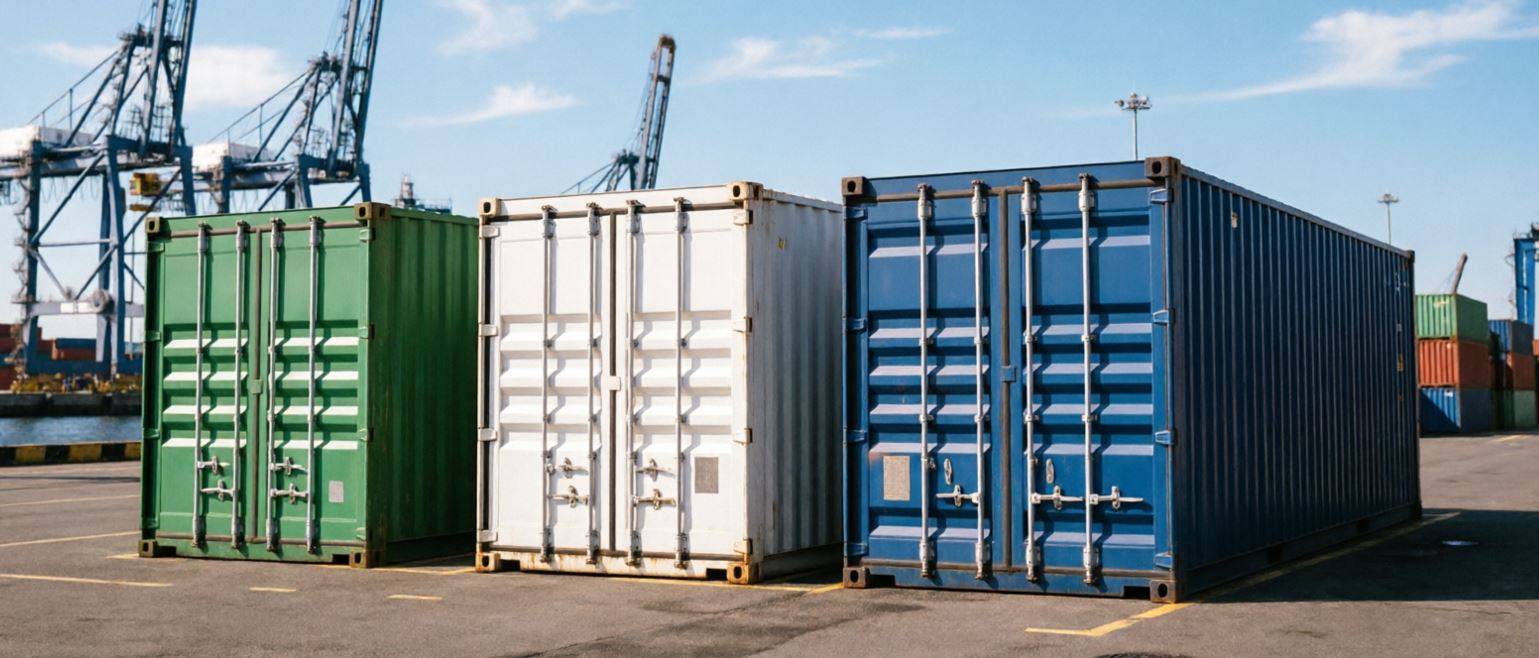
If you look at a large seaport terminal, it resembles a giant Lego board: blue, yellow, orange, green, and white boxes stacked several tiers high. A natural question arises: does the color of a shipping container carry any technical or logistical information, or is it simply a matter of aesthetics?
In this article, we will break down in detail why containers are painted in different colors, whether there are any functional exceptions, and how the shade of the container can affect your cargo and budget.
The Main Reason: Corporate Branding
In 95% of cases, the color of a shipping container is purely a marketing decision. International ISO standards strictly regulate dimensions, strength, corner fittings, and markings, but they do not restrict paint color in any way.
Every major shipping line or leasing company uses its corporate color for quick visual identification of its fleet in ports worldwide. Here are a few classic examples:
Light blue: Maersk (the world's largest operator).
Yellow: MSC (Mediterranean Shipping Company).
Orange: Hapag-Lloyd.
Green: Evergreen Marine.
Bright pink (Magenta): Ocean Network Express (ONE).
Blue with a red logo: COSCO.
For port workers and logistics professionals, this color coding simplifies the sorting and locating of equipment belonging to a specific company.
Functional Exceptions: White, Silver, and Custom Colors
Despite the dominance of corporate colors, other shades are found in the market, and they have practical justifications.
1. White Containers
White is the most common exception to the "branding" rule. It has two key advantages:
Thermoregulation: White reflects sunlight rather than absorbing it. In hot climates or during prolonged exposure to the sun, the temperature inside a white container can be 5–10°C lower than inside a dark (blue or red) one.
Universality: Leasing companies often order white containers because they look neutral and clean. They are easier to repaint for a specific lessee's needs or to use for transporting goods that require visual cleanliness (e.g., in the food industry).
2. Silver or Gray Containers
These are often containers coated with a special anti-corrosion primer, or equipment belonging to specific leasing funds that do not engage in active sea freight but lease equipment long-term for overland use.
3. Custom Containers
When purchasing a container for modification (into an office, shop, summer cottage, or warehouse), the owner can order any color from the RAL catalog. This is a purely aesthetic decision that helps integrate the module into the surrounding architecture or make it stand out on a construction site.
Does Color Affect Cargo Preservation?
Yes, but only indirectly, through the thermal regime.
If a Dry Van container is loaded with heat-sensitive goods (chocolate, certain chemicals, electronics, cosmetics) and sits in the baking sun for several days at a port in Dubai or Singapore, a dark container will turn into an oven. Inside, the so-called "container rain" (condensation) can form, where hot, humid air cools down at night and drips onto the cargo.
In such cases, logistics professionals strongly recommend ordering white containers or using additional insulation and desiccants. For refrigerated (reefer) containers, color is less critical since the temperature is maintained by an active cooling unit, but a white color still reduces the load on the unit and saves fuel/electricity.
Does Color Affect Cost and Certification?
Certification (CSC and ISO): Color has no effect on the ability to obtain a safety certificate. Red and white containers of the same dimensions will pass inspection based on the exact same criteria.
Cost: Standard corporate colors (used or One-Way) are usually the cheapest, as their supply on the market is maximized. White containers or custom-painted units can cost 5–15% more due to the specifics of the paint and lower production volumes.
Practical Conclusion
When ordering sea freight, the container's color does not matter unless you are shipping heat-sensitive cargo during the hot season—in which case, you should request a white box from the shipping line.
When purchasing a container for stationary overland use, the choice of color becomes a matter of practicality and design. White protects better from overheating in the summer, dark colors might be preferable in cold climates for minimal passive heating, and bright, non-standard colors can help your business stand out. The most important thing is that the quality of the paintwork meets marine painting standards, effectively protecting the steel from corrosion.
*The information on this page does not constitute a public offer.
*MyContainers is a partner of MyWay.