



When we think of a sea container, we usually picture mountains of standardized goods: consumer electronics, textiles, toys, or furniture. And that is true: around 90% of the world's non-bulk cargo travels this way.
However, the remaining 10% shatter all stereotypes. Thanks to the container's ability to provide airtight sealing, climate control, and the highest level of security, these steel boxes are used to transport cargo worth tens or even hundreds of millions of dollars.
In this article, we have compiled a collection of the most astonishing, unusual, and expensive cases from the history of container shipping.
1. Masterpieces of World Art and Historical Artifacts
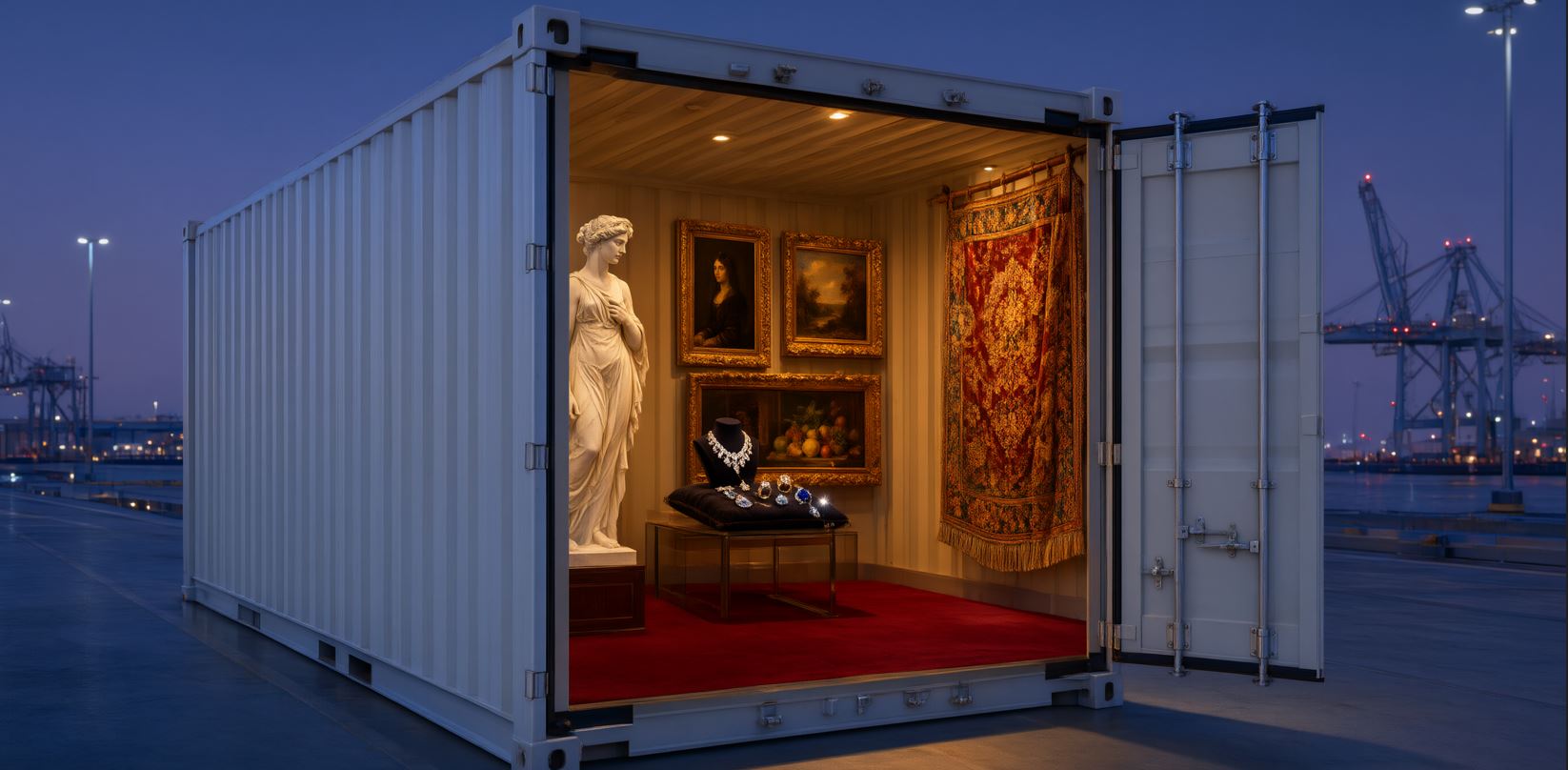
Museums and auction houses increasingly use sea freight for international exhibitions, as it is safer and more predictable than air travel, which is subject to turbulence and pressure changes.
Old Masters' Paintings: For transporting works by Picasso, Van Gogh, or Rembrandt, specialized vault containers are used. They are equipped with climate control systems (maintaining a strict temperature of 18–20°C and 50% humidity), vibration sensors, and multi-layer armor. Inside, the container is lined with soft, fire-retardant materials, and the paintings are mounted on shock-absorbing suspensions.
The Terracotta Army: When the famous warrior statues from the tomb of Emperor Qin Shi Huang were sent to exhibitions in the US and Europe, each warrior was transported in an individual protective cradle (custom dunnage) inside a climate-controlled container, accompanied by armed guards and Chinese restorers.
2. Aerospace Industry and High-Tech Equipment
Space exploration doesn't always start at Cape Canaveral; sometimes it begins at a factory warehouse, where components are shipped in a standard (but heavily modified) container.
ISS Components and Satellites: Satellite parts, telescopes, and even rocket launch vehicle elements (e.g., from SpaceX or Airbus) are often transported in Open Top or Flat Rack containers. The main challenge here is not weight, but cleanliness and the absence of vibration. Such containers are equipped as mobile "clean rooms" with HEPA air filtration systems and pneumatic suspension to dampen any shocks during handling.
Nuclear Reactors: Sections of active cores or specialized equipment for submarines and icebreakers are transported in reinforced containers with multi-layer lead shielding and real-time radiation monitoring systems.
3. Luxury Goods: Supercars and Fine Wines
Container logistics has become the standard for the premium segment, where storage conditions are more important than speed.
Classic Cars: Classic Ferraris, Rolls-Royces, or rare Porsches rarely fly by plane due to the risk of cabin pressure drops. They are loaded into ventilated containers on soft tie-downs. Ventilation prevents condensation, which could cause chrome corrosion or mold on leather interiors during a two-week voyage.
Vintage Wines and Whiskies: Shipments of wine like Château Lafite Rothschild or collectible Japanese Yamazaki whisky are transported in reefer (refrigerated) containers set to "wine mode": a strict 12–14°C and 70% humidity. Any deviation of 2 degrees can irreversibly ruin the beverage's profile, so these containers are equipped with IoT sensors transmitting data every minute.
4. Living Creatures and Biological Treasures
Although air freight is more common for animals, sea containers also play a vital role in global bio-logistics.
Horses and Zoo Animals: Specially modified reefer containers are used to transport breeding stallions or rare animals between continents. Inside, stalls, automated watering systems, ventilation, and video cameras are installed for continuous veterinary monitoring.
Global Seed Vault: Samples of rare plants and seeds for international genetic resource banks (e.g., to replenish the famous "Doomsday Vault" in Svalbard) are transported in small, ultra-reliable thermal containers with liquid nitrogen cooling.
5. Curiosities and "Lost" Cargo: When the Unusual Goes Viral
History knows cases where the contents of containers became public knowledge in the most unexpected ways.
The Great Journey of the Rubber Ducks (1992): A container ship caught in a storm in the Pacific Ocean lost several containers filled with bath toys (the famous "Friendly Floatees"). Tens of thousands of ducks, turtles, and frogs were caught in ocean currents. Oceanographers used them to study global currents, and some specimens washed ashore in Alaska, Scotland, and even Antarctica 15 years later.
The Sneaker Treasure (2021): Off the coast of Canada, In October 2021, the container ship Zim Kingston lost 109 containers overboard during severe weather off the coast of British Columbia. A fire subsequently broke out on board. One of the most "valuable" losses was a container with 4,000 pairs of Nike sneakers. Locals and "treasure hunters" fished out the wet but new sneakers, which were later sold on eBay with a huge markup as a collectible curiosity.
The Logistics of the Impossible: How Does It Work?
Transporting such cargo requires going beyond standard procedures:
Customization of Equipment: Using containers with air suspension, armor plating, or built-in generators.
IoT and Telemetry: Shock sensors that record even the slightest overload, and GPS trackers with anti-jamming protection.
Specialized Insurance: Policies from giants like Lloyd's of London, which cover not only total loss but also "loss of value" (e.g., if a painting is not physically damaged but was subjected to stress that reduces its market value).
Escort Services: For highly valuable cargo, private security firms are hired to escort the container from the shipper's door to the consignee's door.
Practical Conclusion
A sea container is not just a metal box; it is a high-tech platform whose capabilities are limited only by the engineers' imagination and the client's budget. While a container is a cost-saving method for standard cargo, for unique valuables, it is the only way to ensure predictability, security, and preservation when crossing oceans.
*The information on this page does not constitute a public offer.
*MyContainers is a partner of MyWay.