



Introduction: Why Kazakhstan Has Become a Key Link in Eurasian Logistics
In the context of the global restructuring of logistics chains between 2022 and 2026, Kazakhstan has taken a strategically important position as one of the main transit hubs of Eurasia. Located at the crossroads between China—the "world's factory"—and the massive markets of Russia, Europe, Central Asia, and the Middle East, Kazakhstan has become a critical link for container shipping.
By the end of 2024, the transit of cargo from China through Kazakhstan set a new historical record, reaching 15.4 million tons, a 22% increase over the previous year. This rapid growth is driven by several factors: the country's geographical location, developed railway infrastructure, simplified customs procedures within the EAEU, and the active development of international transport corridors.
For Russian businesses importing goods from China, understanding the logistical capabilities of Kazakh transit is no longer just an advantage, but a necessity. In this article, we will examine in detail exactly how container cargo from China moves through Kazakhstan, what routes exist, and where it goes next.
Geographical Position: A Natural Bridge Between East and West
Kazakhstan boasts a unique geographical location—it borders China to the east, Russia to the north, Central Asian countries to the south, and has access to the Caspian Sea to the west. This makes it an ideal transit corridor for delivering cargo from China to the following destinations:
Russia (the main direction, accounting for 60–70% of transit)
Central Asian countries (Uzbekistan, Kyrgyzstan, Tajikistan, Turkmenistan)
Europe (via Russia or the Trans-Caspian route)
Iran and Persian Gulf countries (via the INSTC "North-South")
The Caucasus (Azerbaijan, Georgia, Armenia)
The total length of Kazakhstan's railway network exceeds 16,000 kilometers, a significant portion of which is electrified and modernized to handle heavy container trains.
Key Border Crossings: Gateways for Chinese Containers
Several major border crossings operate on the border between Kazakhstan and China, each with its own specifics and specialization. According to the State Revenue Committee of the Ministry of Finance of the Republic of Kazakhstan, the main volumes of transit pass through the following checkpoints:
1. Khorgos (Kazakhstan) / Nur-Zhol – Khorgos (China)
Type: Road and rail
Location: Almaty region, about 300 km from Almaty
Capacity: Up to 2,500 vehicles per day
Specialization: Universal cargo flow, containers, general cargo
Features: The busiest crossing, operating 24/7 since August 2023. Khorgos is not just a border crossing, but an entire logistics hub with a dry port, customs terminal, and storage zones. This is where the main transshipment of containers from the Chinese gauge (1435 mm) to the Kazakh gauge (1520 mm) takes place.
2. Dostyk (Kazakhstan) / Alashankou (China)
Type: Rail
Location: Zhetysu region, on the shore of Lake Alakol
Capacity: One of the most powerful rail crossings
Specialization: Container trains, bulk cargo, oil and petroleum products
Features: Operates around the clock (since April 2023), with priority given to container trains. Dostyk-Alashankou is a strategically vital crossing for transit to Russia and Europe. A significant portion of container trains following the "China – Kazakhstan – Russia" route passes through here.
3. Altynkol (Kazakhstan) / Korgas (China)
Type: Rail
Location: Zhetysu region
Specialization: Container shipping, general cargo
Features: An alternative crossing to relieve the load on Khorgos and Dostyk.
4. Maikapchagai (Kazakhstan) / Zhumunay (China)
Type: Road
Location: East Kazakhstan region
Capacity: Up to 200 vehicles per day
Specialization: Road transport, small cargo batches.
Main Transit Routes: Where Cargo from China Goes
Containers arriving from China via Kazakhstan are distributed across several key directions. According to freight analytics, the transit structure is as follows:
Direction 1: Kazakhstan → Russia (60–70% of transit)
This is the main flow, passing through the Dostyk and Altynkol border crossings. Cargo travels along the Trans-Siberian and Baikal-Amur Mainlines to the following regions:
Central Russia (Moscow, Moscow region) – about 40% of the total volume
Urals (Yekaterinburg, Chelyabinsk, Tyumen) – 20–25%
Siberia (Novosibirsk, Krasnoyarsk, Irkutsk) – 15–20%
Northwest (St. Petersburg) – 10–15%
Delivery time: 10–15 days from the Chinese border to Moscow.
Main cargo: electronics, auto components, textiles, equipment, marketplace goods.
Direction 2: Kazakhstan → Central Asia (15–20% of transit)
Cargo is delivered to Central Asian countries via Kazakhstan:
Uzbekistan (Tashkent, Samarkand)
Kyrgyzstan (Bishkek, Osh)
Tajikistan (Dushanbe)
Turkmenistan (Ashgabat)
Delivery time: 5–10 days depending on the destination country.
Main cargo: building materials, food products, consumer goods.
Direction 3: Kazakhstan → Europe (10–15% of transit)
The European direction is realized via two main paths:
a) Via Russia and Belarus: The traditional route passing through Russia to Belarus, and further to Poland, Germany, and other EU countries. However, under current geopolitical conditions, this route has become less popular.
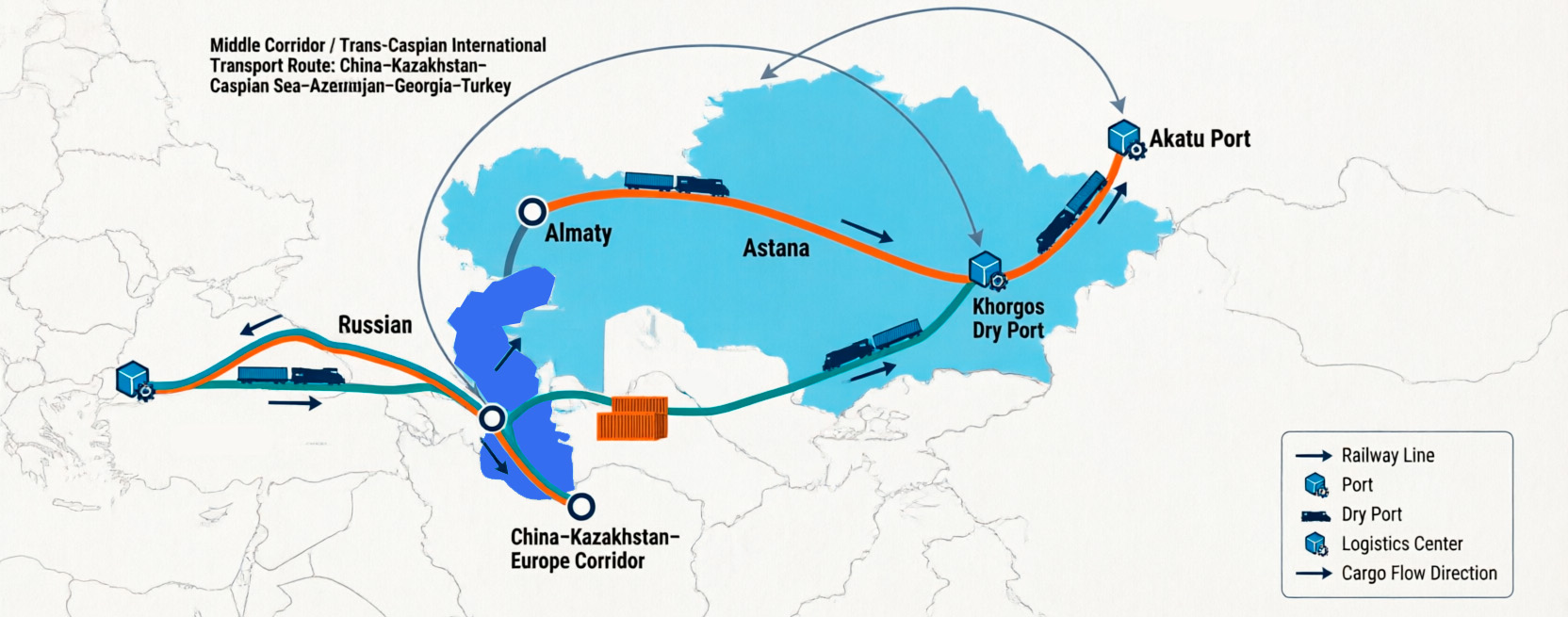
b) Trans-Caspian route (INSTC): An alternative path gaining popularity: Kazakhstan → Caspian Sea (ports of Aktau, Kuryk) → Azerbaijan (Baku) → Georgia (Poti, Batumi) → Europe. This route allows bypassing Russia and delivers cargo to Europe in 18–25 days.
Direction 4: Kazakhstan → Iran and Persian Gulf countries (5–10% of transit)
This direction is developing within the framework of the International North-South Transport Corridor (INSTC). The route passes through:
Kazakhstan → Turkmenistan → Iran → Persian Gulf
Or via the Caspian Sea: Kazakhstan (Aktau) → Iran (Bandar Abbas, Anzali)
Delivery time: 18–25 days to Iranian ports.
Main cargo: grain, metals, building materials, fertilizers.
Statistics and Dynamics: The Numbers Speak for Themselves
The scale of transit through Kazakhstan is impressive. According to official data from the State Revenue Committee of the Ministry of Finance of the Republic of Kazakhstan and "Kazakhstan Temir Zholy" (KTZ), key indicators are as follows:
Total Transit Volume:
By the end of 2024, 15.4 million tons of cargo from China passed through Kazakhstan, a 22% increase compared to 2023.
Bilateral trade turnover between Kazakhstan and China reached a record 32.053 million tons in 2024.
In the first four months of 2025 alone, container cargo transshipment already exceeded 25,000 TEUs, indicating continued growth.
Container Shipping:
In 2024, 358 container trains traveled the "China – Kazakhstan" route, showing a 33-fold increase compared to the previous year.
The volume of cargo transported in containers over 8 months of 2024 amounted to 1.4 million TEUs (twenty-foot equivalents), a 1% increase over the same period in 2023, or 13.3 million tons (+8%).
Transit from Russia through Kazakhstan to China via the Dostyk and Altynkol border crossings grew by 14.5% in the first two months of 2025, reaching 683,000 tons.
Forecasts:
Experts predict that, maintaining current growth rates, transit through Kazakhstan could reach 20 million tons per year by 2026, and the number of container trains could exceed 500 units annually.
Infrastructure: Container Terminals and Logistics Centers
Kazakhstan is actively investing in the development of its logistics infrastructure. Currently, several major container terminals and dry ports operate in the country:
Dry Port "Khorgos": The largest inland port on the border with China, including a border control zone, customs terminal, storage facilities totaling over 100,000 sq. m, a container terminal with crane equipment, and a cross-border cooperation zone.
Container Terminal in Almaty: A distribution center for cargo heading to the southern regions of Kazakhstan and Central Asian countries.
Port of Kuryk on the Caspian Sea: A key hub for the Trans-Caspian route, connecting Kazakhstan's railway network with sea transport across the Caspian to Azerbaijan and Iran.
Terminals in Astana and Shymkent: Distribution centers for domestic logistics and cargo consolidation.
Advantages of Transit via Kazakhstan: Why It Is Profitable
Compared to alternative routes, transit through Kazakhstan offers several significant advantages:
Delivery Speed: Rail delivery from China via Kazakhstan to Russia takes 10–15 days, which is 2–3 times faster than sea freight via Far East ports (25–35 days).
Cost-Effectiveness: According to logistics companies, the cost of rail delivery via Kazakhstan is 20–40% lower than air freight, with comparable timelines. Compared to sea freight, rail is 15–25% more expensive but wins on speed and reliability.
Reliability and Predictability: The railway schedule is less susceptible to external factors (storms, port queues), ensuring supply chain stability.
Simplified Customs Clearance: Within the Eurasian Economic Union (EAEU), customs procedures between Kazakhstan and Russia are significantly simplified, reducing document processing time.
Developed Infrastructure: Kazakhstan is actively modernizing railway tracks, building new terminals, and implementing digital cargo tracking systems.
Multimodality: The ability to combine rail, road, and sea transport within a single route.
Practical Tips: How to Avoid Problems When Transiting via Kazakhstan
Successful organization of delivery through Kazakhstan requires attention to several important nuances:
Choosing a Border Crossing: For urgent container cargo, Khorgos or Dostyk are optimal (maximum capacity). For road transport, Khorgos or Maikapchagai. During peak loads (Chinese New Year, shopping seasons), it is recommended to book crossing slots in advance.
Gauge Change: At the border, containers are transshipped from the Chinese gauge (1435 mm) to the Kazakh gauge (1520 mm). Modern terminals perform this operation in 1–2 hours, but during congestion, the wait time can increase to 3–5 days. It is recommended to build a buffer into the delivery schedule.
Customs Clearance: All documents must be flawlessly prepared: invoice, packing list, bill of lading, certificate of origin. For goods subject to excise taxes or requiring certification, prepare the necessary permits in advance. Work with trusted customs brokers in Kazakhstan.
Cargo Tracking: Use online tracking systems via the container number or railway consignment note (SMGS). Most operators provide real-time location updates.
Insurance: Ensure your insurance policy covers the entire route, including transshipment at border terminals. Standard policies sometimes exclude risks during mode-of-transport changes.
Seasonality: In winter (November–March), delays are possible due to weather conditions. For sensitive cargo, use insulated or reefer containers.
Development Prospects: What Awaits Kazakh Transit in 2026–2030
Kazakhstan does not plan to stop at what has been achieved. As part of the state program for developing transit potential, the following projects are being implemented:
Modernization of Railway Infrastructure: Electrification of the Dostyk – Moynty and Zhezkazgan – Shalkar sections; construction of second tracks on busy sections; implementation of a digital train movement control system.
Expansion of Border Crossings: Increasing the capacity of Khorgos and Dostyk; opening new road crossings to relieve main routes.
Development of the Trans-Caspian Route: Modernization of the ports of Aktau and Kuryk; procurement of additional ferries for the Caspian crossing; integration with the "North-South" corridor.
Digitalization: Implementation of electronic document management; creation of a unified digital platform for cargo tracking; automation of customs procedures.
According to forecasts by the Ministry of Industry and Infrastructure Development of the Republic of Kazakhstan, by 2030, Kazakhstan's transit potential could grow to 30–35 million tons per year, and transit revenues could exceed $2 billion USD.
Conclusion
Kazakhstan has firmly established itself as one of the key transit hubs of Eurasia, connecting Chinese manufacturing with the markets of Russia, Central Asia, Europe, and the Middle East. Record transit figures of 15.4 million tons in 2024 and a 22% year-on-year growth testify to the high demand for this direction.
For Russian businesses, transit through Kazakhstan is not just an alternative, but a strategically important direction offering an optimal balance of speed, cost, and reliability. Developed infrastructure, simplified customs procedures within the EAEU, and active railway modernization make Kazakhstan an attractive logistics partner for the long term.
Planning container delivery from China via Kazakhstan?
We offer comprehensive logistics solutions: rental and sale of sea containers (20DC, 40HC, reefers) of IICL and CW classes, organization of rail and multimodal shipments, and assistance with customs clearance. Contact us to calculate the optimal route and delivery cost.
*The information on this page does not constitute a public offer.
*MyContainers is a partner of MyWay.