



You know the situation: you regularly ship cargo from Asia, but every time you end up paying shipping line agents for demurrage and detention (equipment idle time) because your client at customs or the warehouse fails to unload within the 14 free days. Over a year, these bills can eat up the cost of an entirely new container.
In 2026, purchasing your own equipment (SOC – Shipper-Owned Container) is no longer the exclusive domain of giant corporations. It is a direct tool for protecting margins for importers, agricultural exporters, and manufacturing companies.
However, it’s easy to make a mistake in the container sales market: buying "worn-out" equipment with a leaking roof, or overpaying for a new High Cube when a standard 20-footer would have sufficed. We operate our own fleet and supply equipment directly across 22 cities (China, Russia, Minsk). Here is a detailed guide on how to choose the right container type and condition for your business needs.
The Geometry of Profit: 20DC, 40DC, 20HC, and 40HC
Choosing a container is not just about dimensions; it’s the math of unit cost.
1. 40’ HC (High Cube) — The King of Bulky Cargo
Best for: Textiles, footwear, furniture, home goods, light electronics, bulky auto parts.
The essence: A height of 2.9 m (instead of the standard 2.59 m) provides an extra 12–15% of usable volume.
The economics: If your cargo is light but bulky, shipping it in a 20DC or 40DC means "shipping air." A 40HC can reduce the logistics cost per unit by up to 30%.
2. 20’ DC (Standard) — The Workhorse for Heavy Cargo
Best for: Metal products, machinery, liquids in flexitanks, bulk cargo, heavy equipment.
The essence: Standard length and height.
The economics: Axle weight limits for trucking and rail platforms often prevent loading a 40-foot container "to the brim" with heavy cargo. A 20DC is ideal for dense cargo where the weight limit is reached long before the space runs out.
3. 40’ DC (Standard) — A Rare but Necessary Format
Best for: Medium-density cargo that is longer than what a 20-foot container allows, but doesn't require High Cube height.
The essence: 12 meters in length with standard height.
The economics: Often used for specific equipment or long pipes/profiles that physically don't fit in a 20DC, but paying for the extra volume of a 40HC makes no sense.
4. 20’ HC (High Cube) — A Niche Solution
Best for: Tall but compact and heavy equipment (e.g., specific transformers, vertical machine tools, server racks).
The essence: Combines a short length (for easy maneuvering in tight warehouses) with increased height.
The economics: Avoids complex and expensive disassembly of equipment before shipping, preserving its factory integrity.
Container Condition: ISO (New) vs. Used
The market has a strict division, and understanding the condition grades (IICL, WWT, CW) saves you from financial losses.
ISO / One-Trip / IICL (New or "Zero Mileage")
These are containers that left the factory in China, were loaded once (usually with a test load or just empty), and delivered to the destination port.
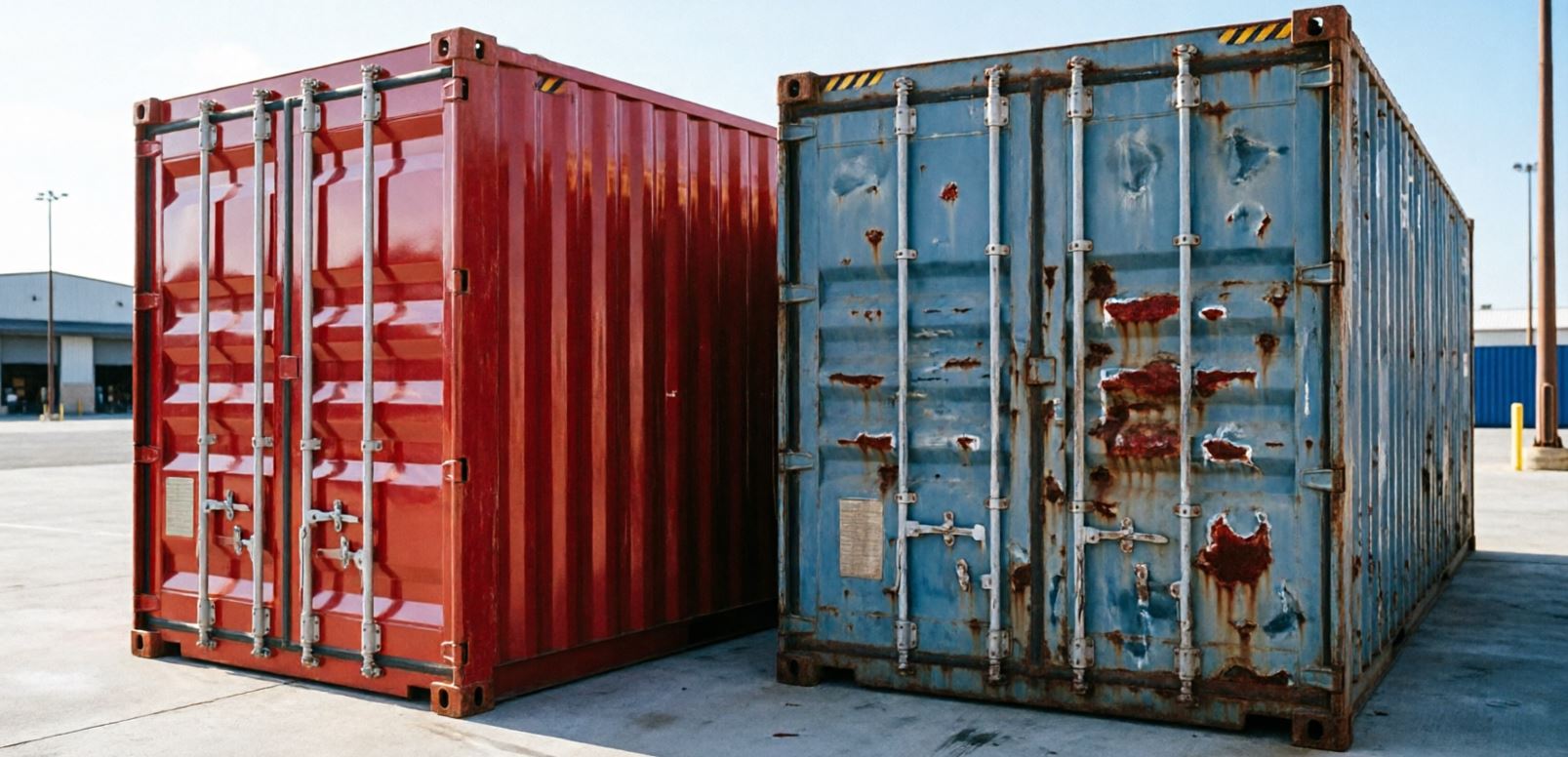
Condition: Perfect geometry, factory paint without chips, plywood or bamboo floor without stains, absolute tightness.
Who it suits:
Retail and premium segment: When the container is used as a mobile showroom or a parcel pickup point.
Food and pharmaceutical industries: Requires zero odors, rust, or dust.
Modular buildings: Perfect wall geometry simplifies insulation and finishing.
Our approach: We provide a full package of photo reports and guarantee the absence of hidden defects.
Used (Cargo Worthy / WWT — Wind and Water Tight)
Containers with commercial mileage. They may have dents on the corrugation, surface corrosion, or patched floors, but they have passed strict tests for tightness and load-bearing capacity.
Condition: WWT guarantees that the roof and doors do not leak, and the floors can withstand the weight of a forklift with cargo.
Who it suits:
Construction companies: Storing tools and materials on-site.
Agricultural exporters and raw material importers: Transporting grain, feed, plastic granules, lumber, where the perfect appearance of the container doesn't matter.
Cost optimization: The price of such a container can be 30–40% lower than an ISO, which is critical for one-off projects or organizing a static warehouse.
Our approach: We do not sell outright scrap (As-Is). Every used container undergoes inspection before sale. You are buying a reliable warehouse on wheels, not a pig in a poke.
Why Forwarders and Importers Buy Equipment From Us
Transparent customs history: All our containers have clean customs declarations. You are buying an asset that can be legally put on the company's balance sheet, claimed for VAT deduction, and used in international transport without the risk of border seizure.
Availability at depots in 22 cities: You don’t need to wait and pay for repositioning an empty container from the port. You can pick up containers from our depot in Minsk, Novosibirsk, Moscow, Almaty, or directly in Chinese hubs (Yiwu, Shanghai, Guangzhou) on the day of payment.
Deal support: We assist with the processing of export/import documents for the containers themselves if you are buying a container in China to ship to the CIS for loading (SOC export).
SOC vs. COC: The Math of Profitability for Forwarders
Until 2024, most forwarders operated on the COC (Carrier-Owned Container) model—renting containers from shipping lines. In 2026, this model has become unprofitable due to three factors:
Parameter | COC (Line Container) | SOC (Own Container) |
Freight cost (incl. idle time) | $2,800–3,500 | $1,800–2,200 |
Detention / Demurrage | $80–150 / day after free-time | $0 — you own the equipment |
Route flexibility | Limited by the shipping line | Any route, any line |
Empty return | Mandatory to the line's port | Not required |
Break-even point for buying a 40' HC:
Container price: ~$3,500
Savings per shipment (vs. COC): $600–900
Payback period: 4–6 shipments (3–5 months with active operations)
*The information on this page does not constitute a public offer.
*MyContainers is a partner of MyWay.