



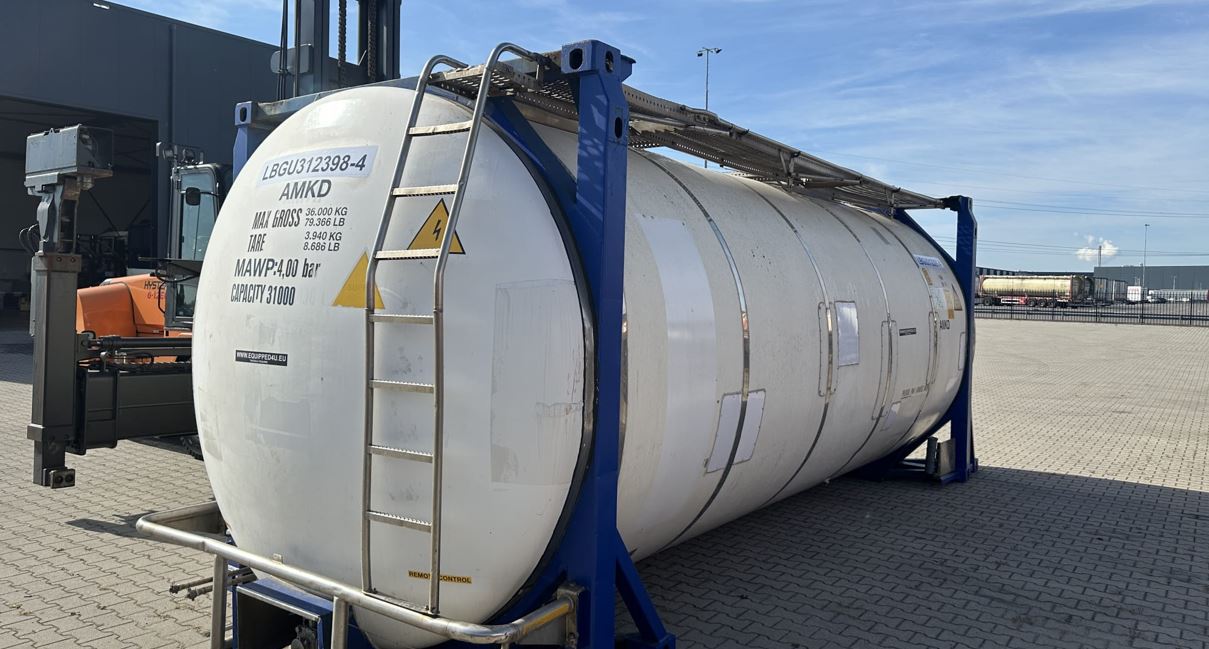
An ISO tank container is a specialized intermodal transport unit designed for the carriage of liquid, gaseous, and powder cargoes. Unlike standard dry freight containers, a tank container consists of a "metal vessel" enclosed within a standard ISO steel frame, enabling seamless multimodal transport by sea, rail, and road without the need for transshipment or devanning.
In this article, we will examine in detail the design of tank containers, their classification, certification requirements, and the specifics of chemical logistics—one of the most complex and high-risk segments of container shipping.
Design of an ISO Tank Container
A tank container consists of several key components, each serving a specific function:
1. Tank (Vessel)
The internal pressure vessel where the cargo is actually stored. It is manufactured from stainless steel (most commonly grades 316 or 304), which is highly resistant to corrosion and chemical attack. The vessel is cylindrical with elliptical or spherical dished ends (heads), ensuring uniform pressure distribution.
2. Frame
The external structure of standard ISO dimensions (typically 20 feet), ensuring compatibility with port gantry cranes, rail flatcars, and truck chassis. The frame protects the vessel from mechanical damage during stacking and transit.
3. Fittings and Valves
The valve system for loading and discharging the cargo:
Manhole (Top Hatch): For internal access during cleaning and inspection.
Bottom Valve: For gravity discharge or pressure discharge of the liquid.
Safety Relief Valves: To vent excess pressure during heating or chemical reactions.
Vapor Return Line: To balance pressure during loading and discharge operations.
4. Insulation and Heating
For cargoes requiring temperature control (e.g., bitumen, paraffin wax, certain chemicals), tank containers are equipped with thermal insulation and heating systems:
Steam Coil: Connected to an external steam source to heat the cargo.
Electric Heating: Heating mats powered by an electrical grid.
5. Additional Components
Protective Cabinet (Spill Box): Prevents contamination and protects valves and fittings from external damage.
Sealing Devices: To prevent unauthorized access and ensure cargo integrity.
Markings: Hazard placards, UN number, and proper shipping name.
Types of Tank Containers: Classification by T-Codes
International standards (IMDG Code, ADR) classify tank containers using T-codes (T1–T75), which dictate the permissible cargo types and transport conditions. The main categories include:
T1–T4: Standard Tank Containers
Working Pressure: Up to 4 bar.
Application: Transport of non-hazardous liquids (foodstuffs, vegetable oils, latex, certain non-hazardous chemicals).
Capacity: Typically 17,500 – 26,000 liters.
T5–T7: Tank Containers for Hazardous Liquids
Working Pressure: Up to 4–10 bar.
Application: Transport of flammable liquids, acids, and alkalis.
Features: Reinforced fittings, additional safety relief valves.
T10–T14: Tank Containers for Liquefied Gases
Working Pressure: Up to 10–22 bar.
Application: Propane, butane, ammonia, chlorine, liquefied natural gas (LNG).
Features: Thick-walled vessels, pressure monitoring systems, thermal insulation.
T50–T75: Cryogenic Tank Containers
Working Pressure: Up to 22–30 bar.
Temperature Range: From -196°C to +20°C.
Application: Liquid nitrogen, oxygen, argon, helium, LNG.
Features: Double walls with vacuum insulation (thermos principle), systems to maintain cryogenic temperatures.
Specialized Types
Gas Tube Trailers: For transporting compressed gases (hydrogen, helium) under high pressure (up to 200–300 bar).
Bitumen Tankers: Equipped with enhanced heating systems for transporting highly viscous petroleum products.
Food-Grade Tank Containers: Made of food-grade stainless steel with a polished internal surface, requiring mandatory sanitary washing and certification.
Certification of Tank Containers
Tank containers are subject to strict control and certification as they carry potentially hazardous cargoes. Key requirements include:
1. CSC Certificate (Convention for Safe Containers)
Like standard dry containers, tank containers must have a valid CSC safety approval plate, confirming structural safety for crane lifting and stacking. The initial validity period is 5 years, followed by periodic examinations every 30 months.
2. RMRS Certification (Russian Maritime Register of Shipping)
For operation within Russia and the transport of dangerous goods, tank containers must be surveyed by the RMRS. The Register issues:
Survey Report: Confirms design compliance with technical requirements.
Certificate of Fitness for the Carriage of Dangerous Goods: Mandatory for sea and rail transport.
3. ADR Certification (European Agreement concerning the International Carriage of Dangerous Goods by Road)
For road transport within Europe and ADR contracting parties, the tank container must comply with the agreement's requirements, including:
Leakproofness tests.
Pressure tests.
Material compatibility verification with the specific cargo.
4. IMDG Code Certification (International Maritime Dangerous Goods Code)
For sea freight, the tank container must comply with the IMDG Code, which defines:
Permissible cargo types for each T-code.
Requirements for fittings and safety devices.
Marking and documentation rules.
5. Periodic Inspections and Tests
Tank containers undergo regular testing:
Hydraulic Test: Structural integrity and leakproofness test under pressure (usually every 2.5–5 years).
Pneumatic Test: Leak test (annually or prior to each loading).
Visual Inspection: Annual check of fittings, valves, and internal surfaces.
Hazard Classes of Cargoes
Tank containers transport cargoes belonging to various UN hazard classes. Understanding these classes is critical for selecting the correct container type and ensuring regulatory compliance.
Class 2: Gases
2.1 Flammable gases: Propane, butane, acetylene, hydrogen.
2.2 Non-flammable, non-toxic gases: Nitrogen, oxygen, argon, helium, compressed air.
2.3 Toxic gases: Chlorine, ammonia, phosgene, hydrogen cyanide.
Class 3: Flammable Liquids
Gasoline, diesel fuel, kerosene.
Solvents (acetone, toluene, xylene).
Alcohols (ethanol, methanol, isopropanol).
Varnishes, paints, adhesives.
Class 4: Flammable Solids
Sulfur, phosphorus.
Metal powders (aluminum, magnesium).
Spontaneously combustible substances.
Class 5: Oxidizing Substances and Organic Peroxides
Hydrogen peroxide.
Nitrates, permanganates.
Organic peroxides.
Class 6: Toxic and Infectious Substances
Pesticides, toxic compounds, biological agents. (Note: While acids and alkalis are sometimes grouped here in general texts, they officially belong to Class 8).
Class 8: Corrosive Substances
Sulfuric acid, hydrochloric acid, hydrofluoric acid.
Caustic soda, caustic potash.
Bromine, chlorine.
Class 9: Miscellaneous Dangerous Substances and Articles
Lithium-ion batteries (in electrolyte).
Asbestos.
Certain polymers and resins.
Chemical Logistics
Transporting chemical cargoes in tank containers is one of the most complex logistics segments, requiring strict adherence to safety regulations and specialized expertise.
1. Selecting the Tank Container Type
The choice is determined by:
Cargo Hazard Class: Each class requires a specific T-code.
Physicochemical Properties: Melting/boiling point, viscosity, corrosive activity.
Temperature Requirements: Some cargoes require active heating or cooling.
Material Compatibility: The vessel must be made of a material resistant to the specific chemical.
2. Loading and Discharging
Loading: Carried out via the manhole or bottom valve using pumps or by gravity. It is crucial to ensure vapor return to balance pressure.
Discharging: Can be done by gravity (for low-viscosity liquids), under inert gas (nitrogen) pressure, or using pumps. For viscous cargoes (bitumen, molasses), heating is applied.
Cleaning: After discharge, the tank container must be washed and purged at a certified cleaning station to remove cargo residues before the next loading.
3. Documentation
Transporting dangerous goods requires an extended document package:
Dangerous Goods Declaration: Contains information on the cargo, hazard class, UN number, and quantity.
Safety Data Sheet (SDS / MSDS): Detailed description of cargo properties, safety precautions, and emergency response procedures.
Tank Container Certificates: Survey report, certificate of fitness for the carriage of dangerous goods.
Emergency Response Information (TREM Card): Action algorithms in case of spills, fires, or other incidents.
4. Marking and Placarding
The tank container must be marked with:
Hazard Placards: Diamond-shaped placards corresponding to the hazard class (e.g., flame for flammable liquids, skull and crossbones for toxic substances).
UN Number: A four-digit code identifying the specific substance (e.g., UN 1203 for gasoline).
Proper Shipping Name: The technical name of the substance.
CSC Plate: Displaying a valid date for the next examination.
5. Transportation
Sea Freight: Tank containers are stowed on the deck of a container ship in designated areas, isolated from living quarters and heat sources, strictly following the IMDG stowage categories.
Rail Freight: Specialized flatcars with securing devices for tank containers are used.
Road Freight: The tank container is mounted on a specialized truck tractor with an ISO tank chassis. The driver must hold an ADR training certificate for the transport of dangerous goods.
6. Storage
Tank containers can be used not only for transport but also for temporary storage of cargoes at terminals or production sites. This requires:
Ensuring ventilation and protection from direct sunlight.
Monitoring temperature (for temperature-sensitive cargoes).
Complying with fire safety rules and segregating incompatible substances.
Practical Conclusion
Tank containers are a high-tech and versatile solution for transporting liquid and gaseous cargoes. They ensure the safety, integrity, and efficiency of chemical, food-grade liquid, and liquefied gas logistics. However, handling tank containers requires in-depth knowledge of chemistry, logistics, and regulatory compliance.
For shippers, the key success factors are: selecting the correct tank container type, meticulous documentation preparation, strict compliance with marking rules, and partnering with experienced logistics operators who hold the necessary certifications and approvals for dangerous goods transport.
*The information on this page does not constitute a public offer.
*MyContainers is a partner of MyWay.