


Complete Guide to Shipping Container Types: Codes, Specifications, and Purposes
In international logistics, every type of equipment has its standardized abbreviation. Understanding these codes (DC, HC, OT, FR) is critically important for selecting the right packaging for your cargo, optimizing transportation costs, and avoiding fines for overloading or improper securing.
MyContainers has prepared a detailed guide to help you navigate the wide variety of shipping containers.
1. Standard Dry Containers (Dry Cargo)
These are the most common types of equipment, used for 90% of general cargo.
Abbreviation | Full Name | Description | Features |
DC (or DV) | Dry Container / Dry Van | Standard enclosed container | Watertight metal box with doors at the end. Comes in 20 feet (20DC) and 40 feet (40DC). |
HC (or HQ) | High Cube / High Quality* | Extra-height container | Height of 2.9 m (instead of the standard 2.59 m). Ideal for bulky but light cargo (furniture, textiles). |
*Note: "HQ" is sometimes used in certain regions, but "High Cube" is the universal industry standard.
Dry Container (DC/DV): The "workhorse" of global trade. Suitable for palletized cargo, bags, boxes, and machinery.
20DC: Withstands heavier weights (up to 28 tons), ideal for heavy cargo (metal, building materials, liquids in containers).
40DC: More length, but the same height.
High Cube (HC/HQ): The main difference is the extra 30 cm in height. This provides about 12–15% additional volume.
40HC: The most popular type for imports from China, as it allows loading more goods without increasing weight.
2. Temperature-Controlled and Specialized Containers
For cargo requiring specific climate control or non-standard loading.
Abbreviation | Full Name | Description | Temperature Regime |
RF (or RH) | Reefer / Reefer High Cube | Refrigerated container | From -30°C to +30°C (depending on the unit model) |
VR | Ventilated Container | Ventilated container | Natural air circulation |
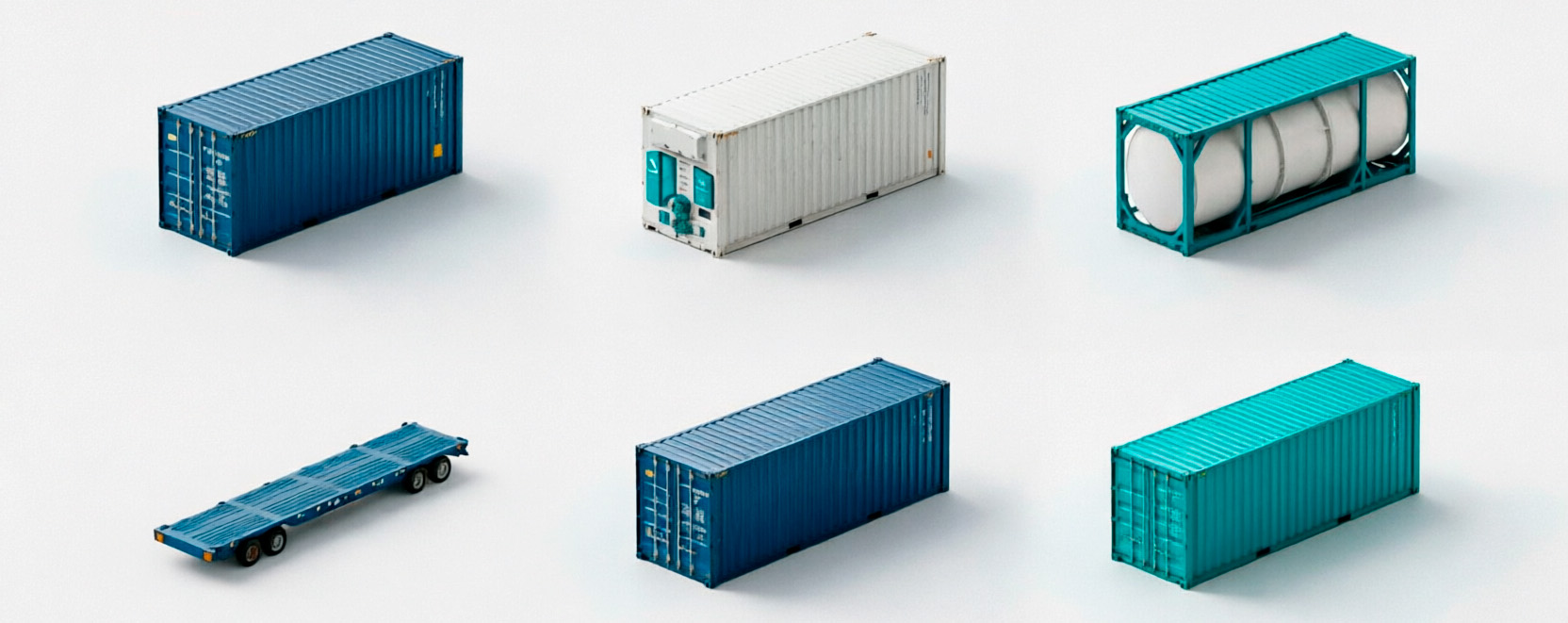
Reefer (RF/RH): Equipped with its own refrigeration unit. Requires connection to a power supply on the vessel, at the terminal, or the use of a diesel generator (genset) during road/rail transport.
Purpose: Meat, fish, fruits, vegetables, pharmaceuticals, chemicals.
Ventilated (VR): Features special openings for air exchange. Prevents condensation ("container rain") that can spoil the cargo.
Purpose: Coffee beans, cocoa, tobacco, nuts.
3. Containers for Oversized and Heavy Cargo
When a standard "box" does not fit the dimensions or weight.
Abbreviation | Full Name | Description | Key Advantage |
OT | Open Top | Container with an open top | Roof loading (by crane) |
FR | Flat Rack | Open platform | No side walls or roof |
HT | Hard Top | Container with a removable roof | Rigid top protection + crane loading |
Open Top (OT): Instead of a rigid roof, a durable canvas tarpaulin is used. The end section often opens as well.
Purpose: Glass, marble slabs, tall machinery, equipment that cannot be loaded through doors.
Flat Rack (FR): Essentially a platform with a reinforced floor and end walls (which can fold down).
Purpose: Pipes, timber, heavy construction equipment, yachts, industrial lines.
Hard Top (HT): A hybrid of DC and OT. The roof is metal but can be removed entirely.
Purpose: Cargo that needs protection from rain but can only be loaded from above.
4. Liquid and Bulk Cargo
Abbreviation | Full Name | Description |
TK | Tank Container | Tank secured in a steel frame |
BU | Bulk Container | Container for bulk cargo |
Tank Container (TK): Designed for transporting liquids and gases. Available in food-grade (for wine, milk, juices) and chemical (for acids, oils) versions.
Bulk Container (BU): Features roof hatches for loading and special openings at the bottom for quick gravity discharge.
Purpose: Grain, plastic granules, fertilizers, cement.
*The information on this page does not constitute a public offer.
*MyContainers is a partner of MyWay.