



Introduction: Why India Has Become a Strategic Priority for Russian Exports
The geopolitical transformation of 2022–2026 has radically shifted the vectors of Russia's foreign trade. Traditional European markets have become closed or difficult to access, while logistics chains via the Suez Canal have faced rising insurance rates, risks of delays, and political instability. Under these conditions, India—the world's second most populous country with a rapidly growing economy—has become a key partner and a strategic hub for Russian exports.
According to the Federal Customs Service of the Russian Federation, trade turnover between Russia and India grew more than fourfold between 2022 and 2025, surpassing the $65 billion USD mark. However, this trade growth is impossible without reliable logistics. The Indian Corridor is not a single route, but an entire ecosystem of maritime, railway, and multimodal pathways that allow Russian exporters to deliver cargo faster, cheaper, and safer than through traditional European hubs.
What is the "Indian Corridor" and Its Main Branches
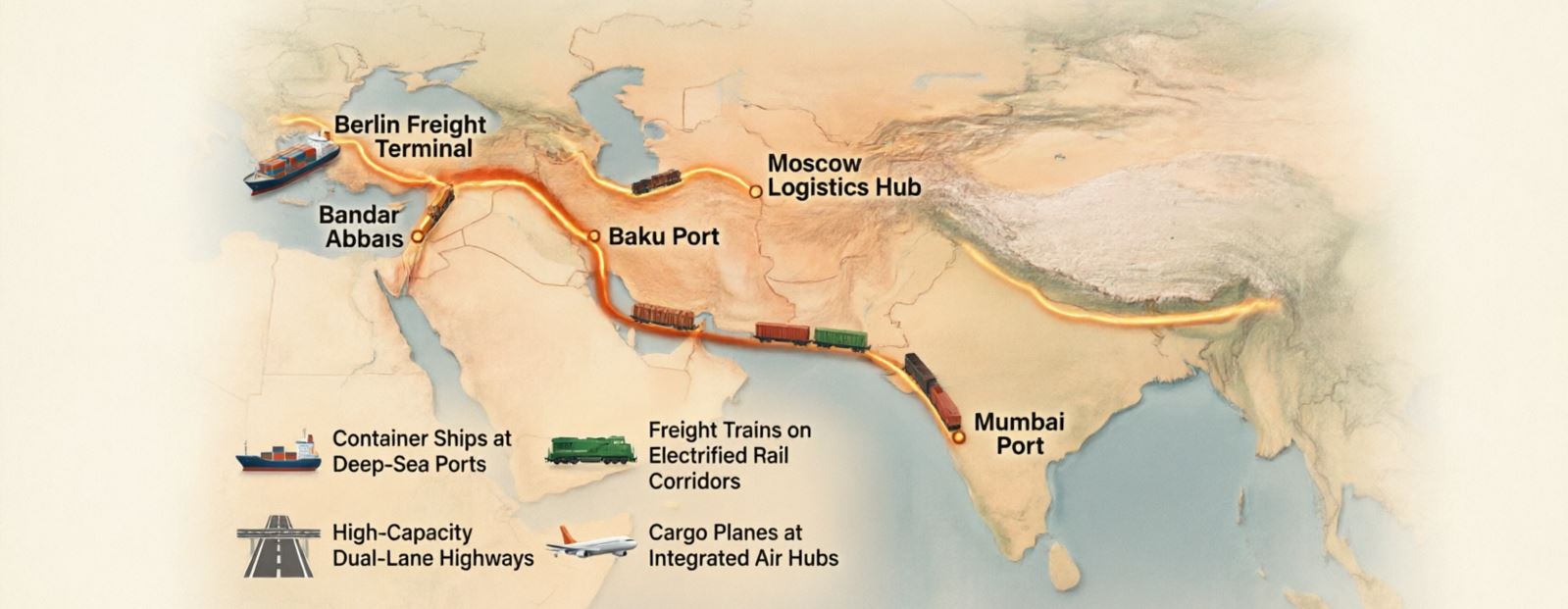
The Indian Corridor is a collection of transport routes connecting Russia with India directly or via transit countries. For containerized and general cargo, three directions are most relevant:
Direct Sea Route (Vladivostok/Nakhodka – Indian Ports): Container ships sail from Russia's Far East ports through the South China Sea to India's east coast ports (Chennai, Kolkata, Visakhapatnam). This route takes 12–18 days and is ideal for exporting Russian seafood, timber, and fertilizers.
Route via Iran and the INSTC: Cargo from central Russia travels by rail or road to Caspian ports (Astrakhan, Makhachkala), then by sea to Iranian ports (Bandar Abbas), and from there via a short sea leg to Indian ports. This is the fastest land-sea route, allowing shippers to bypass the Suez Canal.
Transit via Central Asia and Iran: A railway route through Kazakhstan, Turkmenistan/Uzbekistan, and Iran, exiting to the Persian Gulf ports of India. This path is gaining popularity for delivering Russian metals, chemical products, and grain.
Key Ports of India: Where Russian Cargo Goes
Understanding the specifics of Indian ports is critical for export planning. India has an extensive coastline and over 12 major ports, but the following are most significant for Russian business:
East Coast Ports (Bay of Bengal):
Chennai: The largest port on the east coast, specializing in containerized cargo. It handles about 1.5 million TEUs annually. An ideal entry point for Russian fertilizers, timber, and steel.
Kolkata (Haldia): Located at the mouth of the Ganges, providing direct access to the markets of northeastern India and Bangladesh. It specializes in general cargo and bulk commodities.
Visakhapatnam: A deep-water port important for the transshipment of iron ore and coal, but also actively developing its container terminal.
West Coast Ports (Arabian Sea):
Mumbai (JNPT): India's largest container port, handling over 5 million TEUs annually. The main gateway for Russian oil, petroleum products, and fertilizers.
Kandla (Deendayal): Specializes in bulk cargo and liquids. A crucial hub for Russian grain and vegetable oils.
Cochin: A port on the southwest coast, convenient for deliveries to India's southern states and Sri Lanka.
Statistics and Dynamics: The Numbers Speak for Themselves
According to the Indian Ministry of Commerce and Industry, imports from Russia reached record levels in the 2024–2025 financial year. If Russia's share of Indian imports was less than 1% in 2021, by 2025 it exceeded 8%, making Russia one of India's top 10 trading partners.
In the containerized shipping segment, growth is particularly dynamic. According to a report by the Indian Ports Association, the number of Russian containers passing through Indian ports grew from 45,000 TEUs in 2022 to over 180,000 TEUs in 2025. The bulk of this volume consists of fertilizers (nitrogen, potash, phosphate), timber, metals, and chemical products.
The growth in Russian fertilizer exports is especially indicative: as an agrarian powerhouse, India imports over 30% of its potash fertilizers from Russia. According to the Indian Ministry of Agriculture, over 2.5 million tons of Russian fertilizers were delivered to India in the first 9 months of 2025 alone, a 140% increase compared to the same period in 2022.
Advantages of the Indian Corridor for Russian Exports
Why are Russian exporters increasingly choosing the Indian direction?
Bypassing "Problem" Zones of the Suez Canal: The traditional route to Europe via the Suez Canal faced serious challenges in 2024–2026: increased piracy in the Red Sea, a 200–300% surge in insurance premiums, delays due to inspections, and sanction-related pressures. The Indian Corridor allows cargo delivery to South Asia, Africa, and even the Middle East while avoiding these risks.
Competitive Delivery Times: A direct sea route from Novorossiysk or Far East ports to Mumbai or Chennai takes 14–20 days, which is comparable to or even faster than the Suez route when accounting for all delays. The multimodal route via Iran (INSTC) reduces delivery time to 18–25 days from central Russia to India's west coast.
Logistics Cost Savings: According to Russian logistics companies, using the Indian Corridor can reduce overall transport costs by 15–25% compared to traditional routes. This is achieved through shorter distances, lower insurance rates, and optimized multimodal schemes.
A Growing Sales Market: India is not just a transit hub, but a massive consumer market. With a population exceeding 1.4 billion and a middle class growing at 5–7% annually, Russian goods (from fertilizers and metals to food and diamonds) enjoy stable demand.
Cargo Specifics: What Russia Exports to India
The structure of Russian exports to India via this corridor is quite diverse:
Bulk and Breakbulk Cargo: Fertilizers (potash, nitrogen, phosphate) – up to 40% of total export volume; coal and coke; grain (wheat, barley) and vegetable oils; metals (steel, aluminum, copper).
Containerized Cargo: Timber and lumber; chemical products; equipment and spare parts; precious stones and metals.
Specialized Cargo: Petroleum products (tanker shipments); Liquefied Natural Gas (LNG); Seafood (in reefer containers).
Practical Tips: How to Avoid Problems When Exporting to India
Successful operations in the Indian market require an understanding of local specifics:
Customs Clearance: Indian customs is known for its bureaucratic complexity. All documents must be flawlessly prepared: commercial invoice, packing list, bill of lading, certificate of origin (Form ST-1 or general form), and specific certificates (phytosanitary for timber and grain, quality certificates for metals). Any error can lead to a 2–4 week cargo delay and fines.
Payment Specifics: Due to sanction restrictions, direct settlements in USD and EUR are difficult. Most transactions are now conducted in national currencies (rubles and rupees) through special correspondent accounts or via banks in third countries (UAE, Armenia). Agree on the payment mechanism with your Indian partner in advance.
Container Selection: For long sea voyages under conditions of high humidity and temperature fluctuations, it is critically important to use IICL or CW class containers. Cheap used "As-Is" containers may not withstand 20–30 days at sea, leading to cargo damage from corrosion or moisture.
Insurance: Ensure your insurance policy covers all stages of multimodal transport, including transshipment at transit ports. Standard policies often exclude risks in certain regions, so special coverage extensions are required.
Development Prospects: What Awaits the Indian Corridor in 2026–2030
Experts predict a further increase in the significance of the Indian direction. According to Eurasian Development Bank estimates, trade turnover between Russia and India could reach $100 billion by 2030, which will require an increase in the throughput capacity of logistics routes.
Several infrastructure projects are currently underway:
Modernization of Chennai and Visakhapatnam ports to increase container throughput.
Development of railway infrastructure within the INSTC framework.
Creation of specialized terminals for transshipping Russian fertilizers and grain in Indian ports.
Launch of regular container lines between Russian and Indian ports.
Additionally, India is actively investing in the development of the Chabahar port in Iran, which could become an additional hub for Russo-Indian trade, providing a shorter exit to the Indian Ocean.
Conclusion
The Indian Corridor has ceased to be just an alternative; it has become a strategic priority for Russian exports. The combination of a growing market, reliable logistics routes, and political support makes this direction one of the most promising for the coming decades. For Russian exporters, this is an opportunity not only to bypass logistics restrictions but also to enter a massive market with a billion-plus population.
Planning exports to India?
We provide comprehensive logistics solutions for Russo-Indian trade: rental and sale of sea containers (20DC, 40HC, reefers) of IICL and CW classes, organization of multimodal shipments, and assistance with customs clearance. Contact us to develop the optimal delivery scheme for your cargo.
*The information on this page does not constitute a public offer.
*MyContainers is a partner of MyWay.