

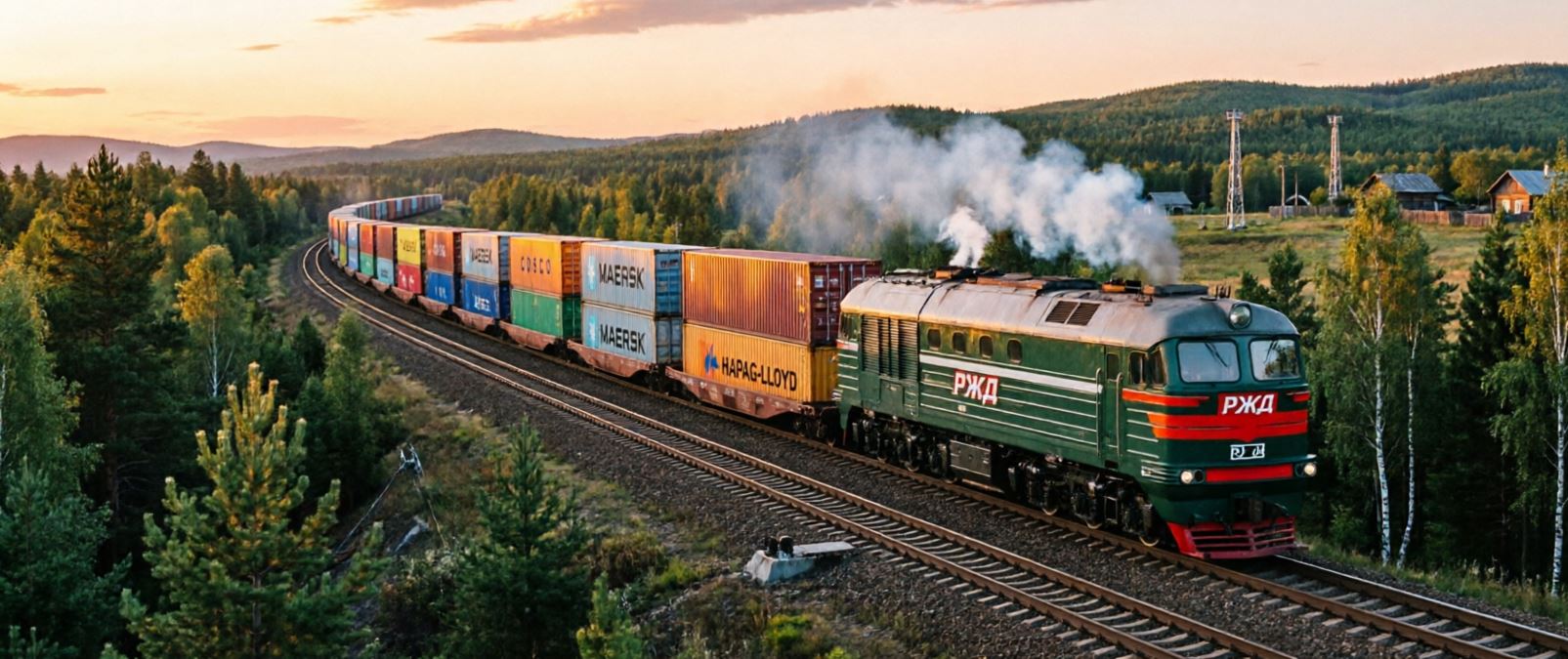
Introduction: The Global Shift of Container Shipping Toward Land Arteries
As traditional maritime routes via the Suez Canal face geopolitical turbulence, rising freight rates, and the risk of delays, global logistics is undergoing a massive reorientation. For the People's Republic of China, the "world's factory," it is critically important to have a reliable, predictable, and fast channel for distributing goods to Russia and European countries.
The answer to this challenge has been the transformation of the Trans-Siberian Railway and the Baikal-Amur Mainline (BAM) from historical transport arteries into a high-tech "Eastern Polygon" (Eastern Range). Today, this is not just a railway; it is a true "gold mine" for Chinese exports and an irreplaceable solution for Russian businesses that value time and cargo safety.
What is the "Eastern Polygon" and Its Role in Container Shipping
The Russian Railways (RZD) Eastern Polygon is the combined network of the Trans-Siberian and Baikal-Amur Mainlines, connecting central Russia with the Far East ports and land borders with China and Mongolia.
In the context of container shipping, this route represents a multimodal corridor that allows cargo to be delivered directly from China's industrial hubs (Chengdu, Chongqing, Xi'an, Harbin) to Moscow, St. Petersburg, or further into Europe. A key feature of this route is its ability to handle heavy and high-cube containers (20DC, 40HC, reefers), giving them priority movement as part of expedited container trains.
Why It’s a "Gold Mine" for China: 4 Key Factors
According to RZD reports and analytics from Chinese logistics associations for 2024–2025, the attractiveness of this route for Chinese shippers is driven by the following reasons:
Unprecedented Delivery Speed: Transit time for a container train from central Chinese provinces to Moscow averages 14–18 days. For comparison: multimodal delivery via Far East ports, accounting for maritime queues and rail legs, can take 25–35 days, while the classic sea route via the Suez Canal takes 35–45 days or more. For goods with short life cycles (electronics, fashion, auto components), this is a decisive factor.
Independence from Maritime "Bottlenecks": The land route completely eliminates risks associated with strait blockades, storms, or vessel capacity shortages in the world's oceans.
Direct Access to the EAEU Market: The railway allows for "door-to-door" delivery without intermediate transshipments at seaports, minimizing the risk of container damage and theft.
Tariff Stability: While ocean freight rates are subject to sharp seasonal and market fluctuations, rail tariffs are regulated by long-term agreements and remain more predictable for budgeting.
Growth Statistics: The Numbers Speak for Themselves
The scale of development on this route is confirmed by official data. According to Rosstat statistics and RZD reports, cargo turnover in the container shipping segment on the Eastern Polygon demonstrates steady double-digit growth.
If in 2020, around 300,000–350,000 TEUs (twenty-foot equivalent units) passed through border crossings with China annually, by the end of 2024–2025, this figure confidently surpassed 500,000 TEUs, with a forecast of reaching 600,000+ TEUs by 2026. Chinese customs also note that the share of overland rail transport in China's total exports to Russia has grown from 15% to nearly 30% over the past three years, directly indicating a shift in logistics priorities.
Key Border Crossings and Logistics Nuances
Successful transportation along the Trans-Siberian and BAM is impossible without understanding the specifics of border junctions. The main gateways for Chinese containers are:
Zabaikalsk (Russia) / Manzhouli (China): The busiest land crossing. This is where the key logistics operation occurs: the gauge change. Since China uses the standard gauge (1435 mm) and Russia uses the broad gauge (1520 mm), containers are transferred from Chinese flatcars to Russian ones either via cranes or by swapping bogies. Modern terminals in Zabaikalsk can process dozens of trains per day, minimizing downtime.
Grodekovo (Russia) / Suifenhe (China): An important crossing in the south of the Primorsky Krai, focused on cargo from China's northeastern provinces.
Far East Ports (Vladivostok, Vostochny, Nakhodka): Used in multimodal schemes where a container arrives by sea from southern Chinese ports and then travels via the Trans-Siberian deep into Russia.
Which Cargo Chooses the Railway?
Not every cargo is cost-effective to ship by rail. The "gold mine" works best for high-value-added goods, where the cost of downtime exceeds the tariff difference between sea and rail:
Electronics and home appliances: Smartphones, PC components, household appliances.
Auto components and vehicles: Parts for assembly lines, tires, accessories.
Industrial equipment: Machine tools, pumps, tools.
Marketplace goods: Clothing, footwear, home goods requiring rapid warehouse replenishment (FBS/FBO).
Perishable goods: Transported in specialized reefer containers (vegetables, fruits, frozen semi-finished products).
Challenges and Growth Points: Modernization of the BAM and Trans-Siberian
Despite its colossal potential, the route faces challenges. The main one is infrastructure throughput capacity. To solve this, a large-scale modernization program for the Eastern Polygon is underway (including the third phase of the BAM and Trans-Siberian expansion).
The construction of second tracks, electrification of sections, implementation of a digital train movement control system, and the expansion of marshalling yards will increase the throughput capacity to 180–200 million tons per year by 2030. This guarantees that the "gold mine" will not run dry but will become even more efficient.
Conclusion
The Trans-Siberian and Baikal-Amur Mainlines are no longer just historical heritage. Today, they are a high-tech, strategically vital logistics corridor that Chinese businesses use as a "gold mine" for guaranteed access to the Russian and Eurasian markets. For the Russian receiver, this means stability, speed, and control over the supply chain.
Planning rail container delivery from China?
We provide a full cycle of logistics support: from selecting and leasing serviceable containers (20DC, 40HC, reefers) of IICL and CW classes capable of withstanding multiple transshipments, to documentation processing. Contact us to calculate the optimal route and transportation cost.
*The information on this page does not constitute a public offer.
*MyContainers is a partner of MyWay.