



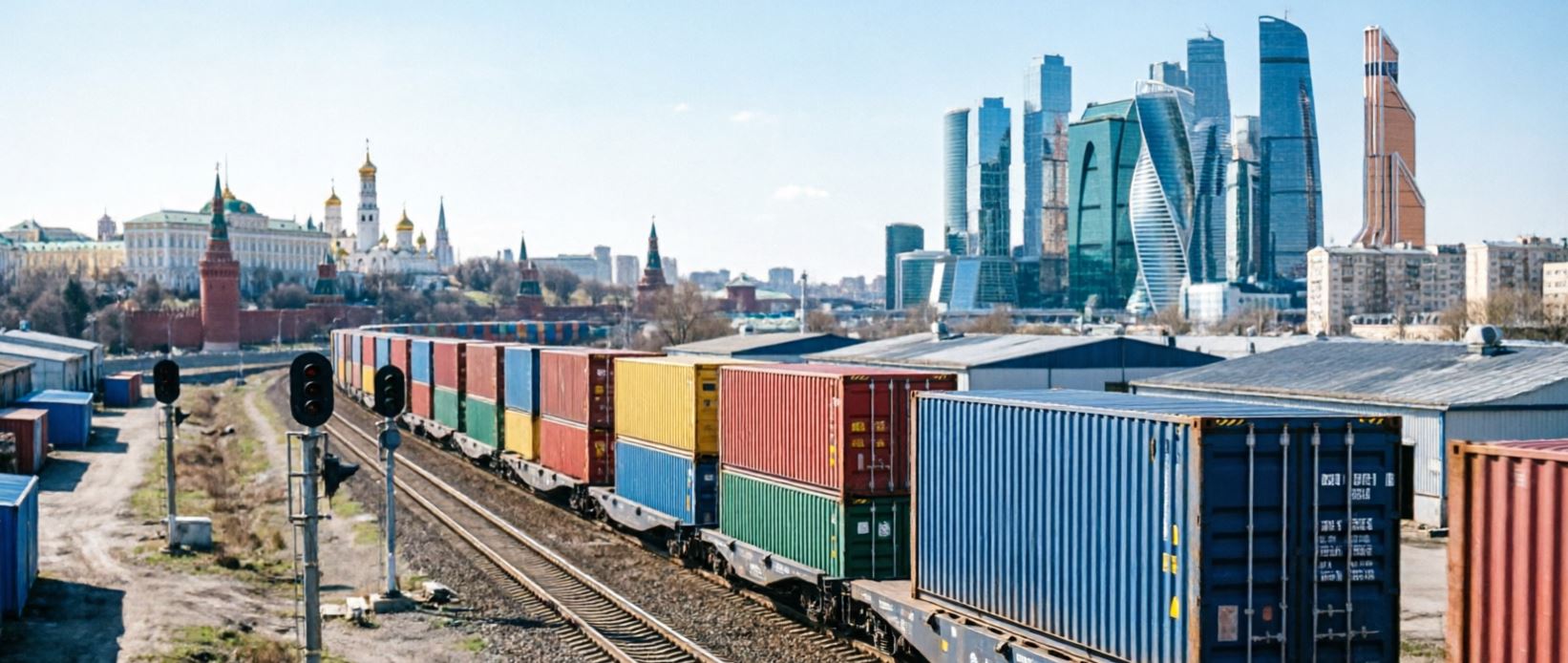
In August, the FESCO transportation group launched a new scheduled container service connecting the Moscow Region and Zabaykalsky Krai. The first train arrived at the Chita-1 station, opening a direct and fast rail link for cargo owners in Central Russia and Zabaykalsky Krai.
This route allows for logistics optimization, avoiding complex trucking legs and ensuring predictable delivery times. Below is a detailed breakdown of the service and the tools MyContainers offers to ensure its seamless operation.
Route Characteristics and Service Parameters
The new service is integrated into a unified logistics network and offers fixed parameters, which is critical for supply chain planning.
Parameter | Value / Description |
Point of Origin | Chekhov TLC (Moscow Region) |
Destination | Chita-1 Station (Zabaykalsky Krai) |
Departure Frequency | Twice a month |
Estimated Transit Time | 9 days |
Planned Volume | Up to 250 TEU per month (the first train arrived with an 80 TEU load) |
Type of Movement | Direct container block train (without disassembly at classification yards) |
Main Cargo and Container Selection
The route focuses on delivering consumer goods, construction materials, and equipment from the central regions to Zabaykalsky Krai and beyond for distribution across the region's districts.
Cargo Category | Recommended Container | Preparation and Logistics Features |
FMCG: Home appliances, textiles, long-shelf-life food products. | 40HC (High Cube) | Maximizes cubic capacity (76.3 m³). Requires reliable internal lashing to prevent cargo shifting during rail shocks. |
Construction Materials & Raw Materials: Tiles, dry mixtures, hardware, rolled metal. | 20DC (Dry Container) | High specific gravity. The 20-foot format is mandatory to comply with weight limits for rail flatcars and cranes in Chita. |
Equipment & Spare Parts: Industrial units, auto parts, agricultural machinery. | 20DC or 40DC | Requires IICL or CW condition with functional hardware. Open Top (OT) may be required for non-standard dimensions. |
Temperature-Controlled Cargo: Food products requiring specific temperature regimes. | 20' RF or 40' RH | Note: The technical feasibility of providing power (reefer sockets) along the entire route must be confirmed in advance with the train operator. |
Technical Specifications of the Container Train
Scheduled container block trains operated by FESCO have priority routing on the Russian Railways (RZD) network, ensuring high speed and predictable delivery compared to single wagon shipments.
Train Parameter | Value / Description |
Train Formation | The train is formed using specialized container flatcars (models 13-4012, 13-470, and equivalents) designed for the safe transport of large-capacity containers. |
Length and Capacity | The standard train length is about 71 conventional wagons. The capacity of a single train varies from 70 to 80 TEU (the first train to Chita arrived exactly with an 80 TEU load). |
Loading Scheme | One container flatcar holds either one 40/45-foot container or two 20-foot containers. Double-loading 20-foot containers optimizes transport costs for high-density cargo. |
Travel Speed | Up to 90 km/h on straight track sections. Container trains have the highest priority category for clearance on mainlines and at classification yards. |
Route Integrity | The train travels directly to its destination without disassembly and assembly operations at intermediate classification humps, minimizing the risk of mechanical damage to the cargo. |
Strict RZD Requirements for Containers for Rail Transport
Rail transport in Russia is regulated by the "Rules for the Transport of Goods in Universal Containers" and the "Technical Conditions for the Placement and Securing of Cargo in Wagons and Containers" (CM-943). Non-compliance with these standards leads to cargo rejection.
Weight Limits and Dimensions:
20-foot containers (1CC, 1C, 20HC): The maximum gross weight (container + cargo) for rail transport is usually limited to 24 tons (up to 30 tons is allowed for some reinforced flatcars and containers, but this requires individual approval).
40- and 45-foot containers (1AA, 1A, 40HC): The maximum gross weight must not exceed 30.48 tons inclusive.
Load Distribution: The weight of a single cargo item inside a large-capacity container must not exceed 1,500 kg to ensure even pressure distribution on the floor and prevent it from caving in.
Technical Requirements and Documentation:
Valid CSC Plate: The container must have an approved "Convention for Safe Containers" (CSC) plate attached to the left door. The Next Examination Date must be valid. Containers with an expired plate are not accepted for transport.
Marking: The gross weight must be clearly marked on the container doors and encoded in the second line of the marking code.
Technical Condition: Transport of containers with through-holes in the corrugation or roof, deformation of corner posts (beyond allowable ISO limits), malfunctioning door locking mechanisms, or damaged floor decking is prohibited.
Cleanliness and Odor-Free: This is especially critical for food-grade cargo. RZD and the consignee have the right to draw up a non-conformity report if there are persistent chemical odors or traces of previous cargo inside.
What to Do If the Container Does Not Meet Requirements?
If violations are detected during acceptance at the Chekhov terminal (e.g., an expired CSC plate or a dent on a corner post), RZD will refuse to load the container onto the flatcar. In this case, MyContainers can provide its own containers and replace your equipment units with serviceable ones from our stock in the Moscow Region, ensuring the train's cut-off time is not missed.
Comparison with Alternative Modes of Transport
Container Block Train vs. Trucking vs. Single Wagon Shipment: Which to Choose?
Criterion | Scheduled Container Block Train (FESCO) | Trucking (Truck) | Single Wagon Shipment (Not part of a block train) |
Delivery Time | 9 days (fixed schedule) | 7–10 days (depends on traffic, weather, driver's hours of service) | 14–25 days (low priority, assembly at classification humps) |
Cost | Medium (optimal balance of price and speed) | High (especially with rising fuel prices and driver shortages) | Low, but with high risks of delays |
Cargo Security | High (minimal transshipments, sealing, no disassembly) | Medium (risk of accidents, driver fatigue, theft at parking lots) | Medium (risk of damage during wagon sorting) |
Seasonal Reliability | High (rail infrastructure is less dependent on snow and ice than highways) | Low (transit times increase in winter due to highway weather conditions) | Medium |
*The information on this page does not constitute a public offer.
*MyContainers is a partner of MyWay.