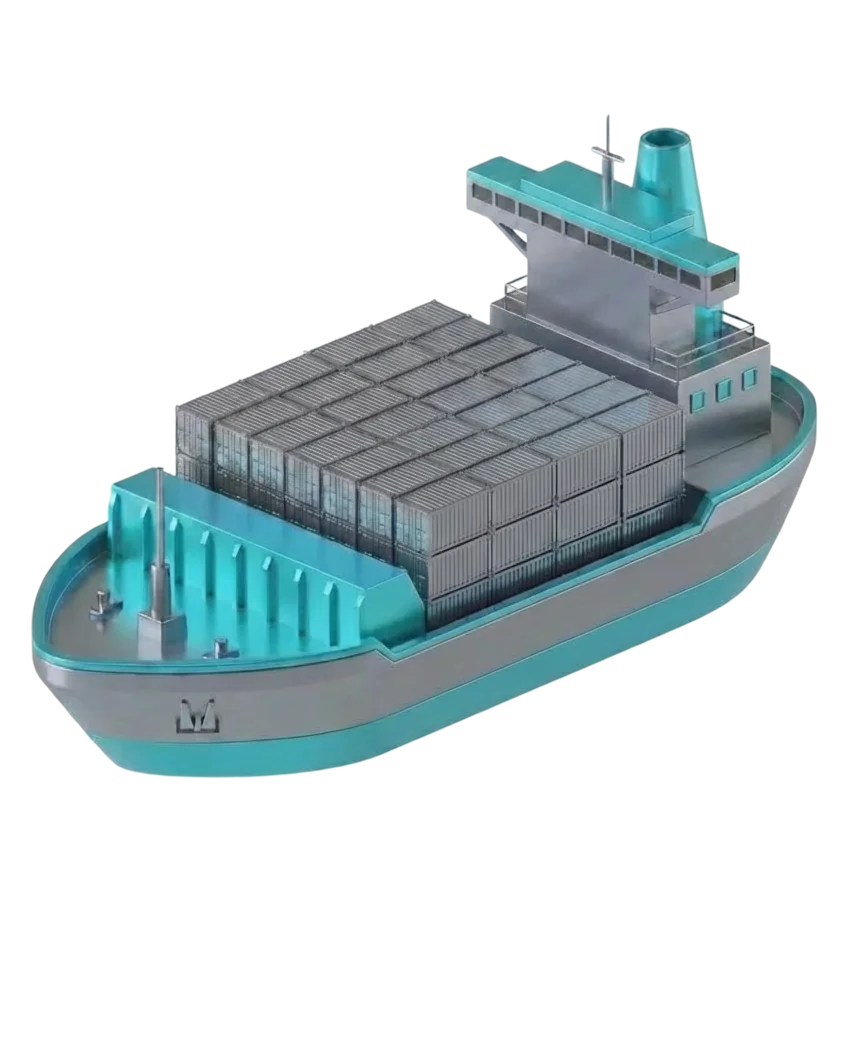

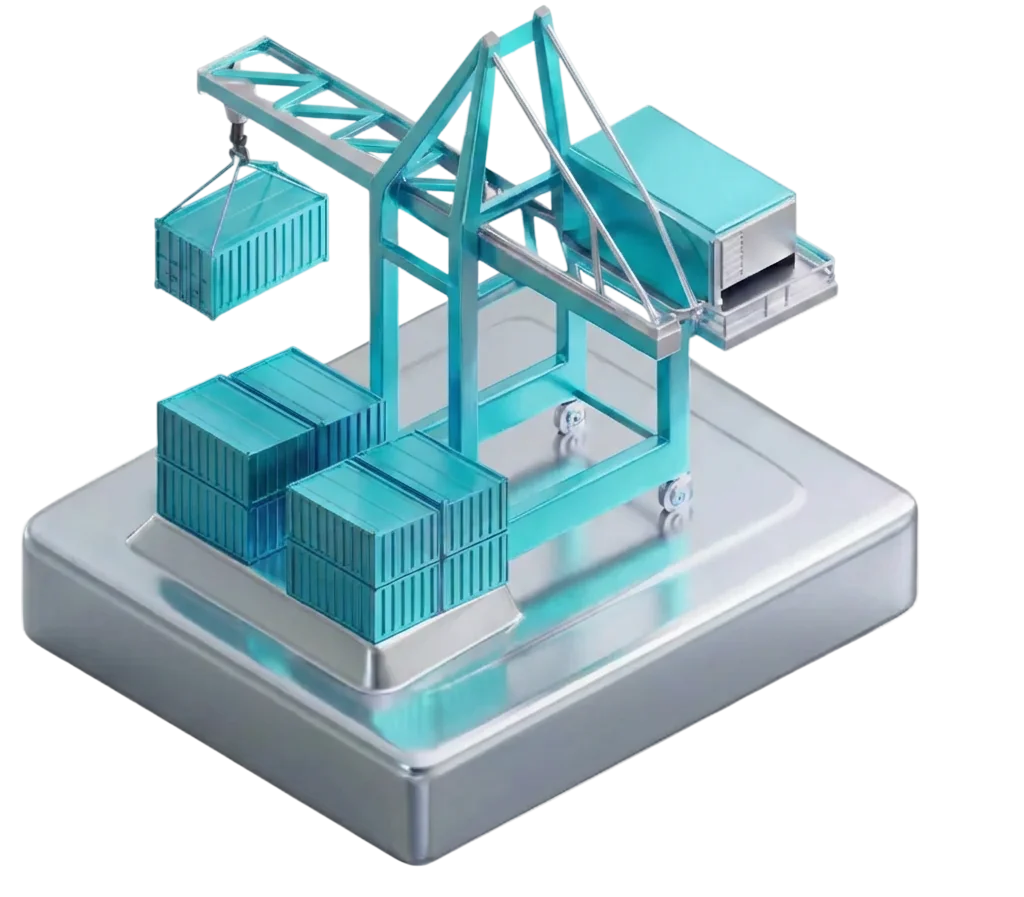




China is Russia's primary trading partner. According to the General Administration of Customs of the PRC, bilateral trade volume exceeded $228.1 billion in 2025. This growth has exposed three systemic problems: equipment shortages, high freight rates, and costly empty repositioning.
Container rental on the China-Russia route reduces logistics costs by 20–35% and solves these challenges for importers, exporters, and logistics operators.
Main Logistics Routes and Their Challenges
Sea Freight
Via Far Eastern Ports: Shanghai/Ningbo/Qingdao → Vladivostok/Vostochny. The most popular route, taking 10–15 days.
Challenge: Port congestion in Vladivostok during peak season (September–December) adds 3–5 days to processing time.
When to choose: For urgent cargo requiring fast delivery to Central Russia via rail.Via Novorossiysk: Shanghai → Suez Canal → Novorossiysk. Takes 30–40 days.
Challenge: Dependency on Suez Canal capacity and potential delays.
When to choose: For cargo destined for the Southern and North Caucasian Federal Districts when urgency is not critical.Via St. Petersburg: Shanghai → Suez Canal → St. Petersburg. Takes 35–45 days.
Challenge: The longest route with risks of delays in the Baltic Sea.
When to choose: Only for cargo destined for the Northwestern Federal District when other routes are unviable.
Rail Freight
Direct Service: Chengdu/Chongqing/Xi'an → Moscow (Cherny Khrebet, Kholino terminals). Takes 15–20 days.
Challenge: Shortage of container flatcars during peak season, with costs potentially rising by 30–40%.
When to choose: For high-value, time-sensitive cargo where speed outweighs cost.Via Kazakhstan: Urumqi → Almaty → Moscow. An alternative route with lower congestion. Takes 18–23 days.
Challenge: Additional customs processing at the Kazakhstan border.
When to choose: When the direct route is congested or too expensive.
Multimodal Schemes
Sea + Rail: Shanghai → Vladivostok → Rail to Moscow. Optimal balance of cost and time (20–25 days).
When to choose: The "golden mean" for most cargo heading to Central Russia.Sea + Truck: Novorossiysk → Truck delivery across the Southern Federal District. Takes 35–45 days + 2–3 days for trucking.
When to choose: For cargo destined for remote regions of the Southern Federal District lacking direct rail access.
Specifics of the China-Russia Route in 2026
The China-Russia direction is one of the most heavily trafficked in global logistics. In 2025, over 2.33 million TEUs passed through Far Eastern ports, with 70% of containers returning to China empty.
The Container Imbalance: The Route's Main Problem
Russia primarily exports raw materials to China (oil, gas, timber, ore) — 65% of exports move in bulk or tanks. Conversely, Russia imports finished goods in containers — 85% of imports move in 20ft and 40ft containers.
Results of this imbalance:
1.75 million empty TEUs are repositioned to China annually.
Container shortages in Russia reach 30–40% during peak season (September–December).
Freight rates on this route increased by 45% between 2024 and 2025.
Free time for importers has been reduced from 14 to 7 days.
This imbalance creates opportunities for optimization. Let's explore how container rental avoids the need to purchase proprietary equipment and cuts logistics costs by 20–35%.
How Container Rental Solves the Imbalance Problem
Container rental (especially One-Way Lease) is a proven method to reduce logistics costs and avoid downtime penalties.
One-Way Lease: Essence and Benefits
One-Way Lease means you pick up a container at one location (e.g., Shanghai), load it, transport it to Russia, unload it, and drop it off at another location (e.g., Moscow or Vladivostok).
How it works
Order a container at the port of loading (Shanghai, Ningbo, Qingdao).
Load it with your cargo.
Transport it to Russia (by sea, rail, or multimodal).
Unload at your warehouse.
Drop off the empty container at the operator's nearest depot.
Key Differences from Shipping Line Rental
No obligation to return the container to the port of discharge; drop it off where it is convenient for you.
No dependency on shipping line quotas; you work directly with the rental operator.
Savings on Demurrage and Detention:
Shipping Line Scenario: 7 days free time (3 days at port + 4 days for delivery/return). Actual time: 15 days. Penalty: 8 days × $75 = $600.
One-Way Lease Scenario: Fixed rental term of 30 days. Actual time: 15 days. Penalty: $0.
Savings: $600 per container. For 10 containers/month, this equals $6,000/month or $72,000/year.
Solving Empty Repositioning for Exporters
If you export goods to China
Take a container on a one-way lease in Russia (Moscow, St. Petersburg).
Load it with your cargo.
Ship it to China.
Drop off the empty container in China (Shanghai, Ningbo, Dalian, and many other locations).
Result: You avoid paying for empty repositioning from China to Russia, saving $800–$1,500 per container.
Why Choose Our Company
1. Container Availability in Key Chinese Ports
We maintain a robust container fleet in major Chinese loading locations:
Shanghai: The world's largest container port by throughput. Located at the Yangtze River estuary. Massive 24/7 automated fleet. Main gateway for central/eastern provinces (Jiangsu, Zhejiang, Anhui). Handles everything from electronics to reefers. Drawback: High congestion, weather delays (fog/typhoons), and higher forwarding costs than neighboring Ningbo.
Ningbo: China's second-largest port by tonnage and a leader in container throughput. Located in Zhejiang province. Powerful 24/7 fleet. Advantage: Less congestion than Shanghai and often better storage/handling rates. Ideal for cargo from Zhejiang, Fujian, and Southeast Asia (textiles, furniture, FMCG near Yiwu/Wenzhou).
Qingdao: The largest universal port in Northern China (Shandong province). Large 24/7 fleet. Vital hub for northern provinces (Shandong, Hebei, Beijing, Tianjin) and transit to Korea/Japan. Specializes in tires, chemicals, appliances (Hisense, Haier), food, and heavy equipment. Stable in winter. Drawback: Distance from southern manufacturing clusters increases inland logistics costs.
Shenzhen/Yantian: Southern China's main port complex, adjacent to Hong Kong. Huge 24/7 fleet, including automated Yantian terminals. Key location for Pearl River Delta cargo (Guangzhou, Dongguan, Foshan, Huizhou). Specializes in high-tech electronics, toys, apparel, and equipment. Advantage: Direct access to global routes (USA, Europe, SE Asia) with short transit times. Lower port fees than Hong Kong, though prone to peak-season congestion (Sep–Oct).
Dalian: Key port in Northeast China (Liaoning province). Important hub for shipments to Japan, Korea, and the Russian Far East. Smaller fleet capacity than Yangtze ports, but excellent for grain, fertilizers, and heavy machinery.
Chengdu: Major logistics hub in Southwest China. Linked to rail routes to Europe via Kazakhstan/Russia. Inland location; cargo is trucked or railed to ports (Chongqing/Shanghai). Ideal for LCL consolidation from western provinces.
Chongqing: Megacity on the upper Yangtze. Major inland rail hub (Chongqing–Europe route). Containers are typically shipped west by rail or barged down the Yangtze to coastal ports (5–7 days to Shanghai). Vital for automotive and electronics.
Tianjin: Northern China's main port (closest to Beijing). Powerful 24/7 fleet. Key location for Europe/USA shipments via northern routes. Handles heavy cargo, steel, and equipment. An alternative to Qingdao for the north.
Guangzhou: Southern China, port on the Pearl River (ranks in China's top 5 by TEU). Huge fleet. Specializes in textiles, footwear, consumer electronics, and FMCG. Perfect for southern provinces (Guangdong, Guangxi).
Xiamen: Important port in Fujian province (east coast). Medium but stable fleet. Great for SE Asia (Singapore, Vietnam) and Taiwan shipments. Frequently used for goods from adjacent industrial zones.
Shenyang: Industrial center of Northeast China. Not a port, but an inland rail hub. Containers are available at rail stations, typically routed via Dalian. Suitable for heavy equipment, auto parts, and steel.
Guizhou: Southwest mountainous province. Deep inland, no ports. Modest container fleet. Cargo is trucked to Guangzhou or Nanning. Rarely used, mainly for local raw materials (phosphates, aluminum) or low-urgency LCL.
Kunming: Capital of Yunnan province, Southwest China. Inland hub near Myanmar, Laos, and Vietnam borders. Limited fleet. Actively used for ASEAN shipments via land routes (truck + rail). For sea export, cargo is trucked to Guangzhou or Shenzhen.
Suzhou: City near Shanghai (Jiangsu province). Not a port, but a massive industrial cluster. Huge container fleet (essentially Shanghai's pre-port zone). Cargo is loaded in Suzhou and trucked to Shanghai (only 100 km) or direct inland terminals. Ideal for high-tech goods (electronics, medical equipment).
Yiwu: City in Zhejiang province — the world-famous wholesale market for FMCG (small commodities, toys, souvenirs, textiles). Inland location. Containers are consolidated into LCL shipments and trucked to Ningbo (~150 km). Highly demanded for small-batch wholesale.
Hefei: Capital of Anhui province (Central China). Inland city, no ports. Medium fleet. Shipments go by truck to Nanjing/Ningbo or rail to Chongqing/Shanghai. Used for electronics and home appliances (major factories are located here).
Taicang: City in Jiangsu province on the Yangtze River, near Shanghai (~50 km). An inland river port with a container terminal. Highly convenient: containers are loaded in Taicang and barged or trucked to Shanghai. Often used as a feeder port to relieve Shanghai's congestion, especially for northern Jiangsu cargo.
Result: You get a container on the day of request, with no queuing!
2. Global Depot Network
Empty containers can be dropped off at our depots worldwide:
Russia: Vladivostok, Moscow, St. Petersburg, Novorossiysk, Yekaterinburg, Novosibirsk, Rostov-on-Don, Kazan, Irkutsk, Khabarovsk, Krasnoyarsk.
China: Shanghai, Ningbo, Qingdao, Shenzhen.
Europe: Poland.
CIS Countries: Belarus, Kazakhstan, Kyrgyzstan, Armenia, Uzbekistan.
Middle East: UAE, Turkey, Egypt, Saudi Arabia, Israel, Iran.
Asia: Singapore, Japan, Vietnam, South Korea, Taiwan, Malaysia.
Other Countries: Mongolia, Bangladesh, India.
Result: You drop off the container where it is convenient for you, not where the shipping line dictates.
3. Transparent Conditions
Fixed pricing with no hidden fees.
Clear terms: rental periods of 30, 60, or 90 days.
4. "Uley" (Hive) Fleet Management System
For clients with large container fleets, we provide access to the "Uley" system:
Real-time container tracking.
Automated document workflow (EIR, handover acts).
Analytics: reports on fleet utilization, costs, and efficiency.
Result: Complete control over your container fleet and total process transparency.
Hive is a product of a partner company
5. Expertise and Support
Personal Manager: Guides your request from start to finish.
Technical Support: Resolves any container-related issues (PTI, repairs, certification).
Flexible Terms: We adapt to your specific operational needs.
*The information in this article does not constitute a public offer.