


The shipping container has long ceased to be just a means of transporting cargo. Thanks to its durability, modularity, and affordability, it has become a true building block for modern architects and designers. Today, steel boxes are used to build not only garden sheds, but also multi-story residential complexes, shopping centers, and entire neighborhoods.
In this article, we will explore the most striking examples of container architecture, starting with the legendary London project, and examine why this trend is taking over the world.
The Pioneer of the Movement: Container City in London (2001)
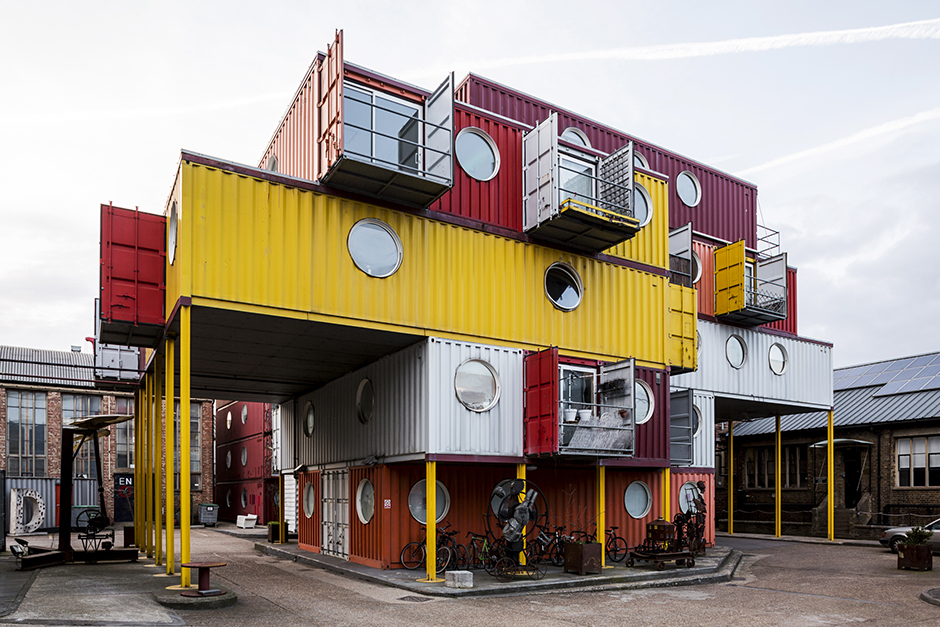
One of the most famous and iconic examples of container architecture is the Container City project in the Trinity Buoy Wharf area of London.
Built in 2001 to a design by architect Nicholas Lacey, this complex was revolutionary for its time. Bright, multi-colored shipping containers were stacked on top of each other, creating a multi-level structure that surprisingly harmonized with the historic industrial landscape of the old port docks.
Purpose: Initially, the complex was created as an inexpensive and rapid solution to provide studios for artists, designers, and small offices. Residential modules were added later.
Innovations: The project proved that containers could not only be stacked but also joined together by cutting out openings to create spacious, light-filled rooms with high ceilings.
Eco-friendliness: Up to 80% of the materials used in construction were recycled, making Container City a symbol of sustainable development.
Global Masterpieces of Container Architecture
The success of the London project inspired architects worldwide. Today, container structures can be found on every continent:
Keetwonen (Amsterdam, Netherlands): One of the world’s largest student campuses built from containers. The complex consists of over 1,000 modules. Each container is equipped with its own kitchen, bathroom, and balcony. The project was completed in record time and became a response to the shortage of affordable student housing.
Boxpark (Shoreditch, London): Marketed as the world’s first "pop-up" shopping mall made of containers. It houses trendy boutiques, cafes, and event spaces. The containers can be easily dismantled and moved to a new location, making it ideal for temporary commercial real estate.
Common Ground (Seoul, South Korea): A massive cultural and entertainment complex consisting of hundreds of bright blue containers. It features streetwear shops, a food court, and concert venues, making it one of the city's main attractions.
Hotels and Hostels: From the "Container Hotel" in Kuala Lumpur to eco-resorts in Chile and South Africa. Containers ensure a rapid business launch and offer a unique industrial style that modern travelers highly value.
Why Have Containers Become a Construction Trend?
Modularity and Speed: Up to 70% of construction work (insulation, wiring, finishing) can be completed in a factory while the foundation is being prepared on-site. Assembling the building on location takes days or weeks, not months.
Durability: Shipping containers are designed to withstand harsh ocean storms and stacking up to 10 tiers high. In land-based applications, their strength margin is more than sufficient and highly reliable.
Eco-friendliness (Upcycling): Using decommissioned containers reduces the need to produce new building materials (like brick and concrete) and gives a second life to thousands of tons of steel.
Mobility: If necessary, a container building can be dismantled, loaded onto a flatbed truck, and moved to a new site without losing the structural value of the components.
Challenges and Limitations of Container Architecture
Despite the advantages, building with containers requires a professional approach:
Insulation and Condensation: Metal is an excellent conductor of temperature. Without high-quality insulation (such as spray polyurethane foam), such a building will be hot in the summer and cold in the winter. There is also a high risk of condensation ("container rain") forming inside the walls.
Loss of Structural Integrity: Cutting large openings for windows and doors weakens the corrugated walls. Such modifications require mandatory reinforcement of the structure with a steel frame.
Regulatory Compliance: In many countries and regions, building codes and regulations are still not fully adapted to non-standard modular buildings, which can complicate the permitting process.
Practical Takeaway
Container architecture has proven its viability: from London's Container City in 2001 to modern multi-story complexes. It is an ideal solution for those who value speed, mobility, and industrial aesthetics. However, for a container to become a comfortable and durable building rather than just a metal box, professional design, high-quality insulation, and strict adherence to modification technologies are critically important.
*Information on this page does not constitute a public offer.
*MyContainers is a partner of MyWay.