



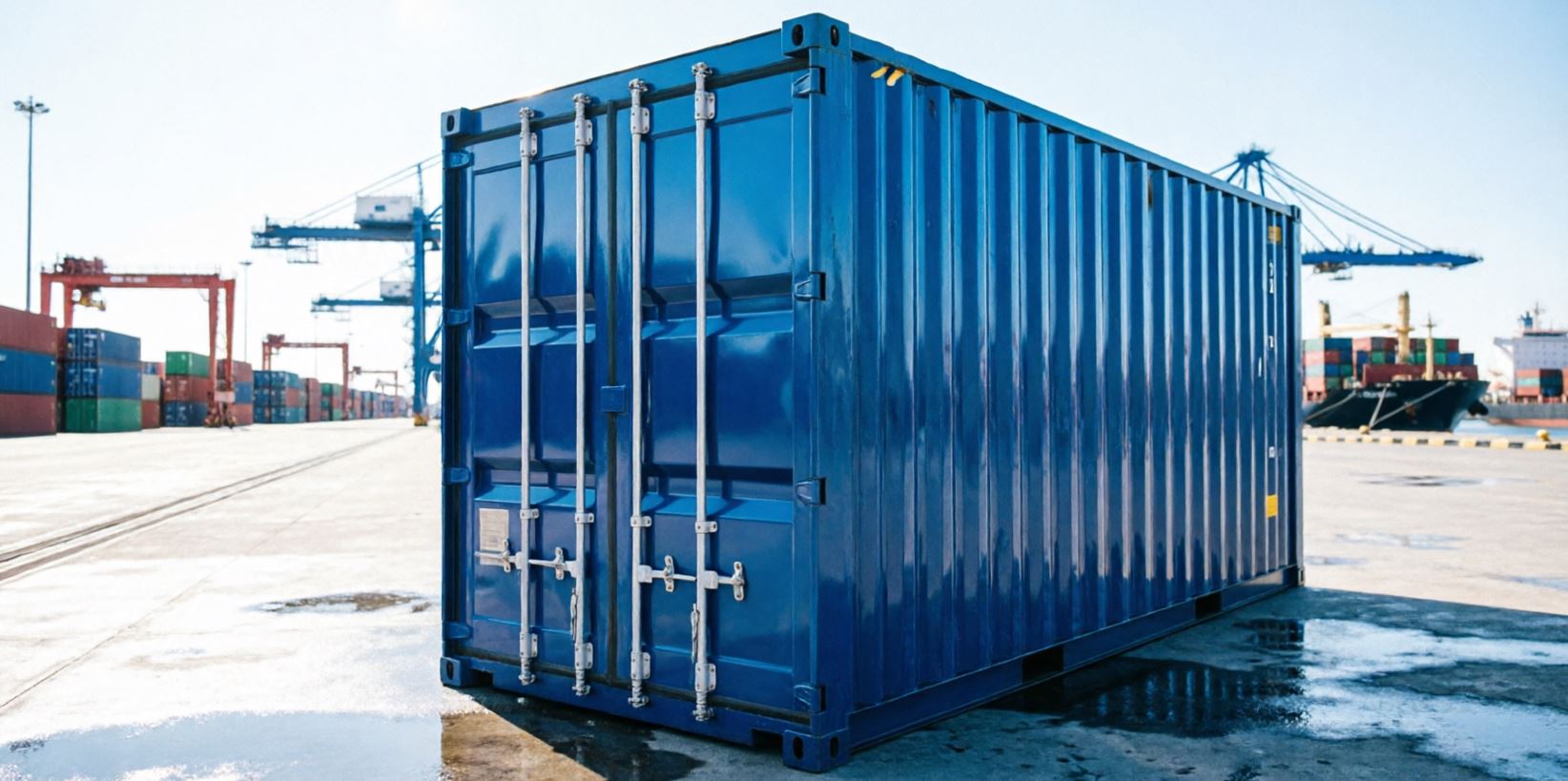
When people think of shipping containers, most immediately picture standard 20- or 40-foot modules. However, the ISO container lineup also includes a lesser-known but highly demanded format: the 10-foot container.
This compact module is the ideal solution for tasks where maneuverability, space efficiency, and limited cargo volumes are key. In this article, we will break down the specifications of 10-foot containers, their advantages, and their areas of application.
Technical Specifications of a 10-Foot Container
A 10-foot container is exactly half the size of a standard 20-foot module (Twenty-foot Equivalent Unit, TEU), but it retains all the key structural elements of a shipping container.
Length: 2.99 m (external), 2.83 m (internal)
Width: 2.44 m (external), 2.35 m (internal)
Height: 2.59 m (standard) or 2.89 m (High Cube)
Usable volume: 15–16 m³ (for standard height)
Tare weight: approx. 1,000 – 1,200 kg
Maximum payload capacity: 10,000 – 11,000 kg
Material: Corrugated Corten steel, resistant to corrosion, with a floor made of marine plywood or bamboo.
Key Differences from a 20-Foot Container
Although a 10-foot container looks like a scaled-down version of a 20-foot one, there are important differences:
Maneuverability and logistics: A 10-foot container can be transported on standard flatbed trucks or small truck-mounted cranes without the need for special oversized load permits. It is much easier to place on a cramped suburban lot or in dense urban development.
Cost per square meter: Paradoxically, a 10-foot container usually costs more per square meter of usable space than a 20-foot one. This is due to lower economies of scale in production and the high proportion of costs associated with corner fittings and door mechanisms, which remain the same as those on larger models.
Capacity: A 10-foot container holds only 4–5 Euro pallets, whereas a 20-foot container can hold 11.
Features of Use in Sea Freight
Despite the name "shipping container," 10-foot containers are rarely used for deep-sea international transportation by major shipping lines.
Reason: Container ships and port cranes are designed to work with 20- or 40-foot slots. Placing a 10-foot container takes up the same slot space as a 20-foot one but generates only half the freight revenue for the shipping line.
Exceptions: They are actively used in coastal (domestic) sea freight, on short-sea shipping routes, and as part of Less than Container Load (LCL) shipments, where a consolidator combines several small batches into a single 20-foot box.
Important: If a 10-foot container is planned for sea freight, it must be equipped with a valid CSC (Convention for Safe Containers) plate. However, many 10-foot models are manufactured exclusively for overland use and do not have this certification.
Main Areas of Application
Thanks to their compact size and durability, 10-foot containers are widely used where standard models are excessive:
Small business and retail: An ideal base for mobile coffee shops, parcel pickup points (PUDO), small stores, fast-food outlets, or rental kiosks.
Private storage: Storing tools, garden equipment, tires, or personal belongings on suburban lots, where installing a 20-foot container might take up too much space or cause neighbor disputes.
Construction sites: Used as a compact, secure warehouse for valuable materials or documentation on sites with limited space.
Modular architecture: 10-foot blocks are convenient for assembling complex modular buildings (offices, restrooms, security posts), as they are easier to transport and install with a truck-mounted crane.
Military and emergency rescue: Compact mobile warehouses, field hospitals, or command posts that can be quickly airlifted by helicopter or transported by small vehicles.
Practical Conclusion
A 10-foot shipping container is a niche but indispensable product. If you need to transport or store a small volume of cargo and space is limited, this format is the best choice. However, before purchasing, it is important to clearly define your goal: if the container will only sit on a plot of land, you can save money by buying a model without CSC certification. If multimodal transportation is planned, a valid certificate is mandatory.
*The information on this page does not constitute a public offer.
*MyContainers is a partner of MyWay.